Zero-Click Search for Small Businesses: How to Turn Visibility Into Leads
Try Thryv for FreeBy Allison Sakounthong, Small Business Expert
Updated November 23, 2026 · 30 min read
Key Takeaways
- Fewer website visits don’t necessarily mean fewer customers. Zero-click searches can generate calls, inquiries, and bookings directly from Google and other search platforms.
- Make it easy for customers to find, trust, and contact your business. Keep your listings accurate, collect recent reviews, and provide clear service information wherever customers search.
- Measure leads and booked jobs, not website traffic alone. Track calls, inquiries, and revenue to understand whether your search visibility is bringing in customers.
Noticing fewer people visiting your business website? You might be wondering whether you’re losing potential customers. But people can now find and call local businesses directly through Google and AI search results, so fewer website visits don’t necessarily mean fewer leads.
Nearly 7 in 10 U.S. Google searches ended without a click from January through April 2026, according to SparkToro. If your website traffic has declined, zero-click searches could be part of the reason.
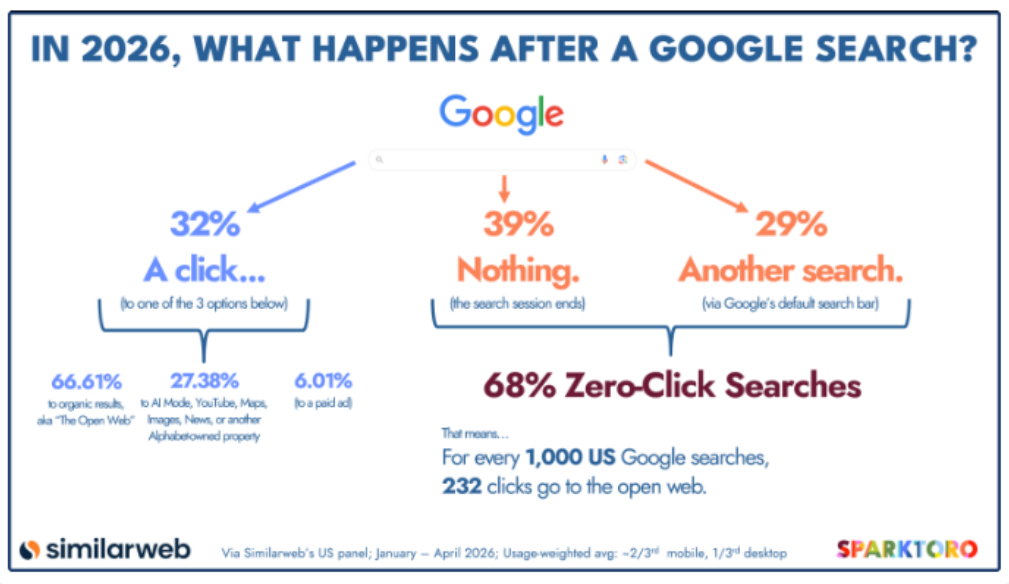
Someone searching for a local plumber, for example, might compare reviews, check business hours, and call directly from Google without ever opening a website. That inquiry may never appear in your website analytics, even if it turns into a booked job.
The key is knowing where customers are finding you, what makes them choose your business, and whether those interactions turn into paying jobs. This guide explains how to capture more leads from zero-click searches and measure the results that matter to your business.
What is zero-click search, and why does it happen?
A zero-click search happens when someone searches on Google or another search platform but doesn’t click through to a website. Instead, they find the information they need directly on the search engine results page.
Is zero-click search traffic increasing? Yes. Zero-click searches are growing because Google now answers more questions on the results page itself. SparkToro found the U.S. share rose from 60.45% in 2024 to 68.01% in early 2026. Search platforms increasingly provide answers and business information through search engine results page (SERP) features, such as featured snippets, knowledge panels, and Google’s Local Pack (the map-based business listings that appear for relevant local searches).
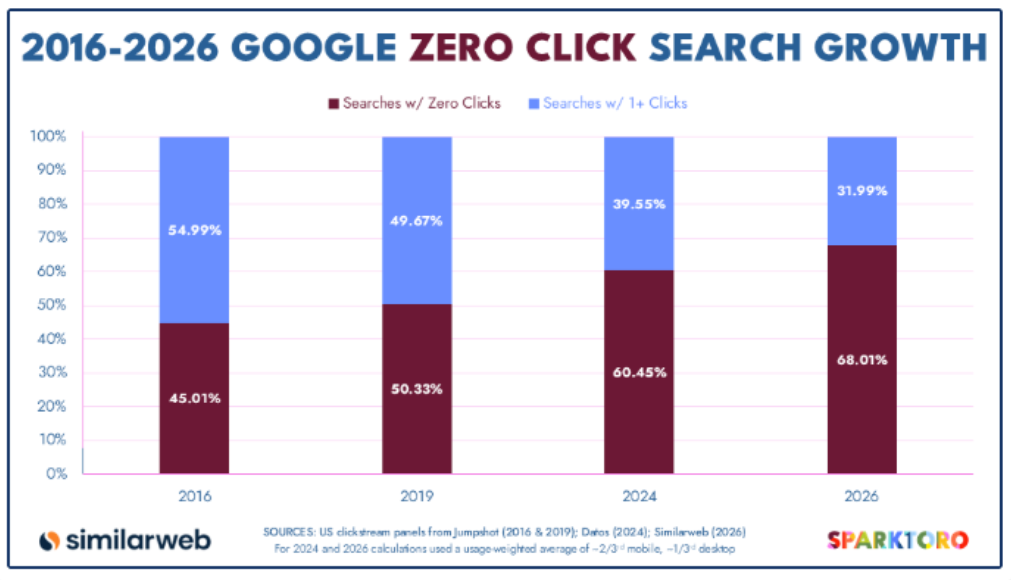
Customers can see hours, phone numbers, reviews, and directions through a Google Business Profile or Google Maps. AI responses summarize information from multiple sources.
These zero-click results serve different needs. Someone researching why their AC isn’t cooling might find an answer and move on. Someone looking for an available repair company could call directly from Google Maps and schedule an appointment without opening a website.
For small businesses, zero-click SEO focuses on making service information accessible and actionable wherever customers search. That’s the core of zero-click marketing: helping people determine whether your business meets their needs and giving them a clear way to get in touch.
How does zero-click search change the way customers choose a business?
Customers once relied more heavily on business websites to compare services, read reviews, and decide who to contact. Today, much of that research happens directly in local search results, where customers can evaluate several businesses before visiting any of their websites.
Say two HVAC companies appear in Google Maps when someone searches for AC repair. One has recent positive reviews, a clear list of services, accurate business hours, and a working phone number. The other has outdated hours, few recent reviews, and limited service information.
[CTA Guide: The HVAC SEO Checklist: Get Your Business Found Faster Online]
Even if both appear prominently, the first company makes it easier for customers to confirm that it can help and request service. The second could lose the call before anyone visits its website.
AI-generated recommendations add another discovery channel. According to BrightLocal’s 2026 Local Consumer Review Survey, 45% of consumers used AI tools for local business recommendations, compared with 6% the previous year.
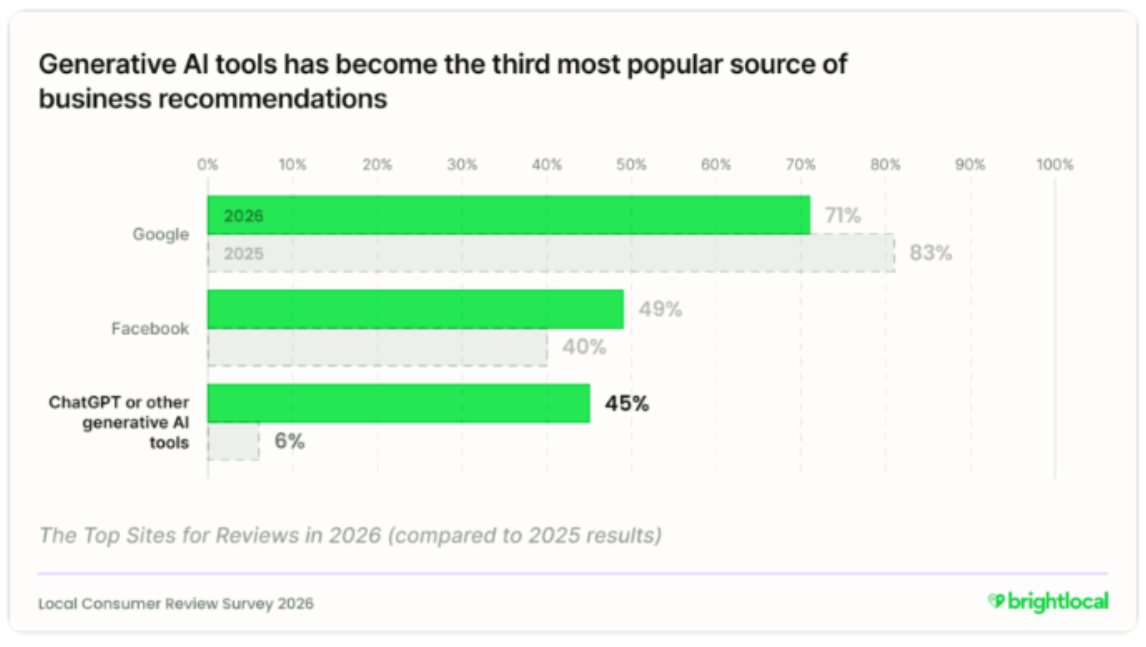
The practical question is whether customers can find enough information to choose your business. Check that your listings accurately describe your services, reflect your current availability, and provide working contact options.
Does AI recommend your business?
Customers may be finding businesses through AI search without ever visiting their websites. See whether your business appears in AI recommendations and where competitors may be getting more visibility.
Where do zero-click searches still turn into leads?
Different results-page features play different roles in bringing customers to your business. Local pack results can generate immediate calls, while reviews, AI recommendations, and informational answers may influence a later decision.
| Where Customers Find You | How It Can Generate Leads | What to Optimize | What to Measure |
| Google Business Profile, knowledge panels, and Maps | Calls, bookings, and other direct interactions | Services, hours, photos, and contact options | Calls, bookings, and direction requests |
| Online reviews | Builds confidence in choosing your business | Recent reviews, ratings, and responses | Review trends, ratings, and related inquiries |
| AI Overviews and AI assistants | Introduces your business to potential customers | Accurate information, useful content, and third-party mentions | AI mentions, available referral data, and inquiries |
| Featured snippets and People Also Ask boxes | Builds awareness by answering customer questions | Clear service information and helpful FAQs | Search impressions and related inquiries |
Google Business Profile and Google Maps
For local service businesses, Google Maps and Business Profiles offer some of the clearest opportunities to generate leads without website visits.
Someone searching for “roof repair near me” may need immediate help. These near-me searches make accurate service details, service areas, and working contact options especially important.
Online reviews
Reviews help customers evaluate businesses and may provide useful information to AI search systems.
According to BrightLocal’s 2026 survey, 85% of consumers are more likely to use a business after reading positive reviews.
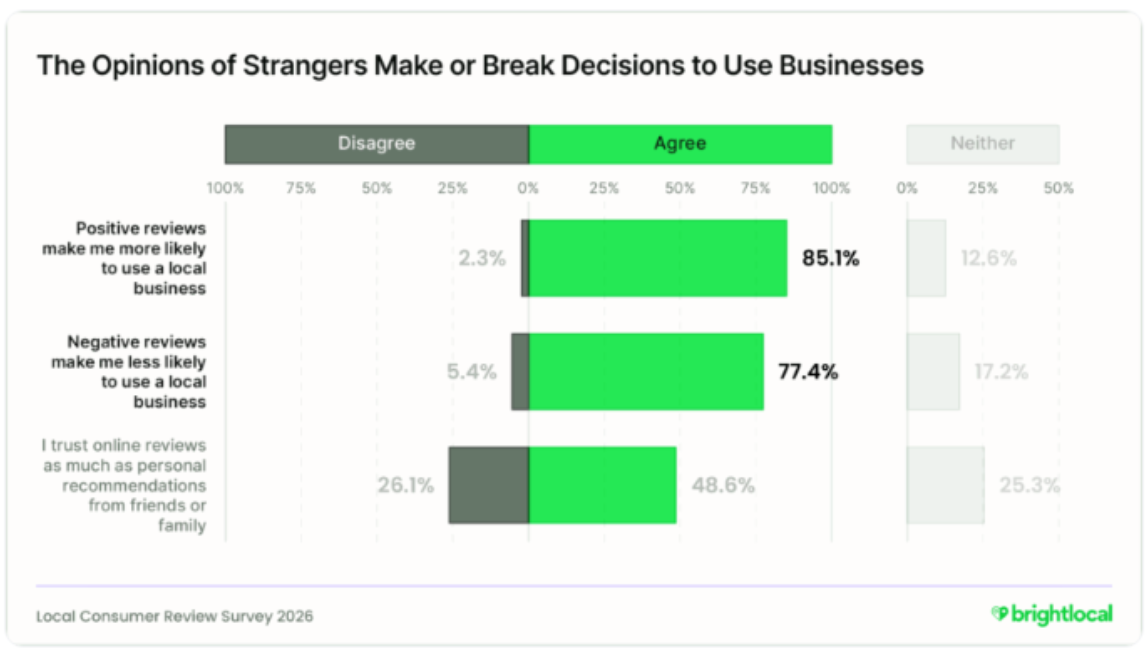
That makes recent feedback and professional responses worth maintaining. Customers comparing businesses can use those experiences to judge whether a company is reliable, which is one reason online reviews matter for local SEO.
AI Overviews and AI Assistants
Google AI Overviews and ChatGPT can introduce customers to businesses through generated answers and recommendations.
Accurate listings, detailed service information, and brand mentions on credible third-party websites can support discoverability. These trust signals help search systems find information about your business, though recommendations vary by platform, location, and question.
Featured Snippets and People Also Ask
Google’s featured snippets and People Also Ask results answer questions directly in search.
For example, a landscaping company answering “When should I aerate my lawn?” could reach customers researching lawn care before they’re ready to hire someone.
Clear service information and helpful FAQs can support awareness and credibility. Optimizing website content for featured snippets and AI answers can create additional opportunities for customers to discover your expertise.
Zero-click search strategy: 5 steps to turn visibility into leads
An effective zero-click search strategy starts with fixing the information customers rely on to find and contact your business.
Use Thryv’s free Small Business SEO/AEO Visibility Checklist to track improvements as you work through these steps.
Step 1: Check how your business shows up today
Search Google for your main service and location, such as “AC repair Tampa.” Review the Maps results and your business profile as a potential customer would.
Can someone confirm that you provide the service they need, serve their location, and are available when they need help? Check your hours, phone number, service descriptions, photos, and reviews.
Then ask ChatGPT a relevant local recommendation question to see whether your business appears. Treat the answer as a snapshot because AI recommendations vary by question, location, and platform.
Run the free Online Presence Scan to identify potential listing issues across other websites.
Record your findings and prioritize anything preventing customers from reaching you. An incorrect phone number, outdated hours, or missing core service deserves attention before an old photo or less important directory listing.
Step 2: Make every listing a conversion point
Customers should be able to confirm that you offer the service they need and contact you directly from the listing whenever that option is available.
Check your business name, phone number, address where applicable, hours, services, and service areas. Test available call, messaging, quote-request, and booking options to make sure they work.
Include details that help customers make decisions. For an HVAC company, that might mean identifying emergency repair availability, the systems serviced, and the neighborhoods covered.
Start with Google Business Profile and the directories your customers use most. Thryv’s Google Business Profile service helps you claim and manage your listing, and its local listings management lets one edit and update your details across multiple directories.
Step 3: Keep reviews recent and respond to every one
Customers want evidence that a business continues to provide reliable service. According to BrightLocal’s 2026 survey, 74% of consumers look for reviews written within the past three months.
Make review requests part of your normal process after completing a job or appointment. Send a short thank-you message with a direct link so customers don’t have to search for where to leave feedback.

Free Guide: Customer Review Strategy for Small Business
Free Guide
Free Guide: Customer Review Strategy for Small Business
Turn customer feedback into a powerful growth tool. This practical guide shows you how to build a consistent review strategy that strengthens trust, improves visibility, supports conversions, and turns positive customer experiences into marketing assets that help drive more business.
The free Google Review Link Generator can help you create that link.
Set aside time to respond to new reviews. Thank customers for positive feedback, and address negative experiences professionally without sharing private details.
If you’re struggling to keep up, Thryv’s Automated Reviews helps send review requests after each job.
Step 4: Answer customer questions so search and AI can cite you
Think about what customers ask before booking your services. What does the job involve? How much might it cost? How soon can you help?
Choose three common questions and answer them clearly on the relevant pages of your website. Include long-tail questions that reflect specific customer needs, such as “How much does it cost to repair a leaking roof after a storm?” Match each answer to the customer’s search intent, or what they’re trying to accomplish.
For example, a roofing contractor could explain when storm damage warrants an inspection, what happens during the appointment, and which neighborhoods the company serves. These answers help customers understand whether the service fits their situation and give search systems more useful information about the business.
If you manage your website, structured data can also help search engines interpret details such as your business name, services, and location. It doesn’t guarantee prominent placement, so prioritize accurate, helpful page content first.
This supports local SEO and local AEO. AEO, short for answer engine optimization, helps AI tools find and quote your business.
Step 5: Respond to calls and messages fast
When customers contact several businesses about the same service, a missed call or unanswered message can mean losing the job.
Decide who handles incoming calls, messages, forms, and appointment requests. Check for missed inquiries throughout the workday, and acknowledge them as soon as possible, even when you can’t provide a complete answer immediately.
For example, you might send: “Thanks for reaching out! I’m finishing up an appointment and will call you back this afternoon.”
Then make sure the callback happens. Keep track of outstanding estimates, unanswered questions, and appointment requests so interested customers don’t get overlooked.
Thryv’s customer communication tools help organize incoming conversations, while available automation capabilities can support consistent follow-up. That gives owners more control over their response process without losing the personal service customers expect.
Get a free visibility audit
No time to tackle these fixes while running your business? Book a free audit, and Thryv’s team will review your website and Google Business Profile, then walk you through what to fix first.
How do you measure zero-click search results?
You can measure local SEO results without relying on website visits by tracking how often your business appears in search, how customers interact with your listings, and which inquiries turn into paying jobs.
Focus on three types of metrics:
- Visibility: Use Google Search Console to monitor how often your website appears in Google Search and which searches generate impressions. Review Maps visibility and AI mentions where measurable. These metrics help you understand your search exposure.
- Customer interactions: Track calls, direction requests, and available messaging or booking activity. Your Google Business Profile Performance report provides supported interaction metrics, including call and direction data.
- Business outcomes: Record qualified leads, estimate requests, booked jobs, and revenue to understand which inquiries produce actual business.
You can start with a simple spreadsheet. For each inquiry, record the date, how the customer found you, what service they requested, whether you provided an estimate, and whether the job was booked.
For example, a landscaping company might see little change in website traffic but receive more calls from Google. If those calls lead to more estimates and booked projects, the owner has evidence that search visibility is contributing to business growth.
Ask new customers how they found you, and use call attribution tools when available. Compare results over consistent periods, such as month over month, while accounting for seasonal demand. Remember that impressions, calls, and direction requests don’t necessarily represent unique leads or paying customers.
The most useful measure is whether your search presence generates more qualified inquiries, booked work, and revenue.
Turn zero-click visibility into leads with Thryv
Keeping business information accurate, managing reviews, responding to inquiries, and tracking results takes ongoing attention. Thryv software helps you handle these tasks without doing each one manually, including the listings and review tools from Steps 2 and 3.
If you need help improving where your business appears in search, Thryv’s Search Boosts provide expert-led SEO and AEO support for traditional and AI-powered search visibility. This can be especially useful when you don’t have the time or expertise to manage ongoing optimization yourself.
Small Business SEO & AEO Visibility Checklist
Free Guide
Small Business SEO & AEO Visibility Checklist
Optimize your business for search engines, AI answers, and zero-click discovery. Use this step-by-step checklist to improve visibility, strengthen trust signals, and turn online searches into real customer inquiries.
Some businesses benefit from both. Search Boosts helps improve search discoverability, while Thryv software supports the ongoing work of maintaining your online presence, managing customer interactions, and understanding performance.
The value of connecting these activities is reflected in Thryv’s 2026 internal client study of 96 participants, which found a 54% increase in online visibility and a 40% increase in leads.* These findings aren’t specific to zero-click searches.
The priority is making sure customers can find your business, get the information they need, and reach you when they’re ready to book. From there, tracking which inquiries turn into jobs helps you decide where to focus your marketing efforts.
Source: Thryv, 2026 internal client study of 96 participants. Individual results may vary.
See where your leads come from
Stop judging search by website traffic alone. See how Thryv tracks your top lead sources, so you know which channels bring in jobs.
FAQs about zero-click search
Yes. Your website gives customers a place to explore your services, learn about your experience, and request an estimate. It also provides detailed information that search engines and AI tools may use when generating answers. Zero-click search creates additional ways to reach customers, but your website remains an important part of your online presence.
Keep your business information accurate across Google and other directories, publish helpful service content, and build credibility through customer reviews and relevant third-party websites. AI recommendations depend on the question, location, and information each platform has available.
Yes, to an extent. Google Business Profile Performance can show available call, booking, and other interaction metrics, depending on your profile’s features. To identify which inquiries become customers, record lead sources and use call tracking or booking records where available.
You can make many improvements for free, including updating your Google Business Profile, correcting listings you manage, and adding helpful website content. Paid software can reduce ongoing manual work, while professional SEO and AEO services offer additional expertise. Costs depend on the support your business needs.
Yes. Thryv software helps you keep business listings accurate, manage your Google Business Profile, and build your online reputation. For businesses that want professional help improving traditional and AI search visibility, Thryv also offers expert-led SEO and AEO services through Search Boosts. It covers both SEO and AEO, so your business can show up in traditional search and in AI tools. Results vary, and placement isn’t guaranteed.