Why Customer Reviews Help with Local SEO for Small Businesses
Try Thryv for FreeBy Allison Sakounthong, Small Business Expert
Updated October 13, 2026 · 28 min read
Key Takeaways
- Reviews can support local visibility while giving customers more confidence to call, book, or choose your business.
- Focus on authentic reviews, recent feedback, positive ratings, and a steady flow instead of chasing a specific review count.
- Build review requests and responses into your routine so your reputation stays current without relying on someone to remember.
You can do great work and still lose the call when a nearby competitor has a stronger, more current review profile. Customer reviews can help your business appear in local search while giving potential customers more confidence to choose you when they find you.
Someone searching for a local service may see several businesses offering the same thing in the same area. One has a steady stream of recent reviews describing real experiences. Another has fewer reviews, and the latest are months old. Those differences can influence which business gets noticed and which one gets the call.
Reviews carry weight in that decision. A 2026 LocalImpact survey found that 88% of consumers have decided against a business after reading negative reviews. For a small business, your review profile can shape someone’s impression before they ever visit your website or pick up the phone.
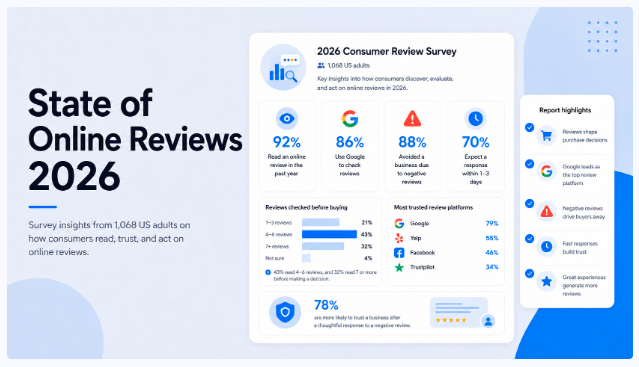
Reviews are also becoming relevant to AI-powered discovery as people use new ways to find and evaluate local businesses. Understanding what matters, from review volume and recency to ratings and responses, can help you build a stronger reputation and a repeatable system for keeping it current.
How Do Customer Reviews Affect Local Rankings?
Customer reviews can help local SEO rankings because they contribute to the signals Google uses to evaluate a business’s prominence, while giving potential customers evidence that the business is active, established, and trusted.
Google says local rankings are mainly based on three factors: relevance, or how well a business matches the search; distance, or how close it is to the searcher; and prominence, or how well-known the business is. Reviews are part of that last factor. Google specifically says that more reviews and positive ratings can help your local ranking.
You can’t control where someone is when they search, but you can strengthen your review profile by consistently earning authentic customer feedback.
Industry research adds more context. In Whitespark’s 2026 Local Search Ranking Factors survey, four review-related signals ranked among the top 20 factors local SEO experts associated with Google Maps and local pack rankings: high Google ratings, the number of Google reviews with text, review recency, and a steady flow of reviews over time. The findings are based on the testing, research, and observations of 47 local SEO experts, rather than factors confirmed by Google.
A strong reputation combines positive ratings, recent feedback, and reviews arriving consistently over time.
Reviews also help customers decide what to do after they find you. A current, credible review profile can give someone more confidence to click, call, or book, helping your business get found and giving customers a reason to choose you.
How Reviews Can Support Visibility in AI Search
Customers are also using AI tools to discover local businesses. BrightLocal’s 2026 research found that 45% of consumers use AI for local business recommendations, and 88% fact-check the reviews those tools cite. A customer might discover your business through an AI recommendation, then turn to your reviews before deciding whether to contact you.
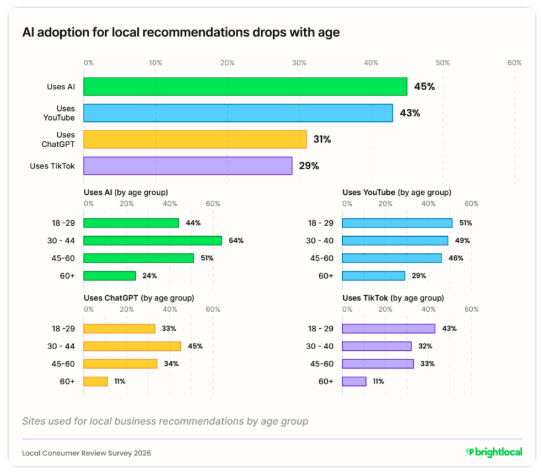
Google already uses AI to summarize common themes and sentiment from reviews in some local listings. These summaries are based on reviews from the past year and are updated regularly to reflect recent opinions.
More reviews don’t guarantee that your business will appear in AI recommendations. Maintaining accurate business information and a steady flow of authentic, detailed reviews gives customers, search engines, and AI-powered discovery experiences more current information about your business and reputation.
4 Review Factors That Impact Local Visibility
A strong review profile depends on more than how many reviews you have. Look at volume, recency, ratings, and the substance of customer feedback to understand where your business may need attention.
Volume: Build a Review Profile That Competes Locally
Google confirms that having more reviews can help your local ranking. More reviews can also give potential customers more experiences to consider when deciding whether they trust your business.
There isn’t a universal number you need to reach. A landscaper in a small town may face a very different competitive landscape than a law firm in a major city. See how your review profile compares with the businesses customers find alongside yours:
- Search Google for several important service-and-location combinations, such as “landscaper in [city]” or “family lawyer in [city].”
- Look at the businesses that consistently appear in the local results.
- Compare their review counts with yours.
If several businesses appearing prominently have significantly more reviews, focus on building a more competitive profile through genuine customer feedback.
Recency: Keep New Customer Feedback Coming In
Recent reviews matter because customers want current evidence of what it’s like to work with your business. In BrightLocal’s 2026 survey, 74% of consumers said they care only about reviews written within the previous three months.
Whitespark’s 2026 survey also identified review recency and a steady flow of new reviews among the factors local SEO experts associate with local pack and Google Maps rankings. Google has not confirmed recency as a local ranking factor.
Check the dates on your last 10 reviews. If they arrived within one short burst followed by months of silence, prioritize a consistent process for asking customers for feedback.
Rating: Give Customers Confidence to Choose You
Your star rating deserves attention for both visibility and trust. Google specifically confirms that positive ratings can help local ranking. For customers scanning several local businesses, the rating also offers a quick indication of the experiences other people have had with each company.
Aim for a rating that reflects consistently strong customer experiences, authentic feedback, and thoughtful responses when problems arise. Look at the story behind the number, too. If several reviews mention missed appointments, poor communication, or another recurring problem, that pattern deserves your attention.

The Ultimate Google Business Profile Guide
Free Guide
The Ultimate Google Business Profile Guide
Learn how to optimize your Google Business Profile to get found online, attract leads, and boost local visibility.
Review Detail: Give Customers Useful Context
Written feedback gives prospective customers more context than a star rating alone. Someone looking for an HVAC company may find it reassuring to read that a technician arrived when promised, repaired the furnace the same day, and clearly explained the problem.
Let those details come naturally from customers. Ask for honest feedback without giving people keywords to include, services to mention, or language to use. Over time, authentic reviews can reveal consistent themes about your service, expertise, and customer experience, giving potential customers a clearer idea of what they can expect.
Quick Review Health Check
Look at your Google Business Profile the way a potential customer would and ask:
- Is my review count competitive with similar businesses ranking locally?
- Are new reviews arriving consistently instead of in occasional bursts?
- Does my rating reflect consistently positive customer experiences?
- Are customers describing their experiences authentically, in their own words?
- Am I responding to both positive and negative feedback?
- Am I avoiding incentives, review gating, and scripting what customers should say?
Then prioritize the issue that can make the biggest difference. If reviews have gone quiet, improve your request process. If you have far fewer reviews than businesses appearing alongside yours, focus on consistently earning more authentic feedback. If customers repeatedly mention the same problem, address the customer experience first. If reviews are coming in but responses are inconsistent, create a response routine or use a tool that makes the process easier to maintain.
How to Get More Google Reviews
Getting more Google reviews works best when asking for feedback becomes a regular part of serving customers. Ask at the right time, give customers an easy way to respond, follow up once if needed, and repeat.
1. Ask at the Right Moment
Ask for a review soon after the customer has experienced the result of your work, while the experience is still fresh.
An HVAC company might ask after the technician finishes the repair and confirms the system is working. A salon could ask after the appointment, while a law firm might wait until an appropriate milestone in the client relationship. Connect the request to a point when the customer has enough experience with your business to give meaningful feedback.
2. Ask Every Customer for Honest Feedback
Make review requests part of your normal process rather than deciding who seems likely to give you five stars.
Keep the request straightforward: “Thanks for choosing us. If you have a minute, we’d appreciate your honest feedback about your experience.”
Let customers describe their experience in their own words without suggesting a rating, keywords, or specific services to mention.
3. Make Leaving a Review Easy
Even a happy customer may put off leaving a review if they have to search for your business and find the right place to leave feedback.
Give them a direct path. Thryv’s free Google Review Link Generator lets you create a one-tap link that you can include in a text message, email, or follow-up after service.
Test the link before sending it to customers to make sure it opens the correct business profile and review page.
4. Follow Up Once
If a customer hasn’t responded, send one brief, friendly reminder with the direct review link. After that, move on and repeat the process with future customers rather than continuing to chase the review.
5. Make Review Requests Part of Your Routine
Review requests are easy to miss when someone has to remember to send them after every job or appointment. Build the request into a repeatable process:
Service completed → review request sent → easy review link → one follow-up → repeat with the next customer
If you want to reduce the manual work, Thryv’s automated review requests can email customers a review request after a completed job, helping you maintain a steady flow of feedback.
Keep the process focused on honest feedback. Google prohibits incentives for reviews, and businesses should avoid review gating, selectively requesting positive reviews, or telling customers what to write.
Start Getting More Google Reviews Today
Get a free review link in seconds and start collecting more Google reviews today.
Why Do Negative Reviews Matter?
Negative reviews matter because they can affect your overall rating and influence what prospective customers expect from your business. Google confirms that positive ratings can help with local rankings, so complaints that pull your rating down can work against your local visibility. The bigger concern is often a pattern of similar complaints rather than one isolated negative experience.
One negative review rarely defines a business. A pattern does. Someone comparing two businesses may read the negative reviews specifically to understand what could go wrong. A complaint about one unusually long wait is different from several recent customers saying appointments routinely started late. Repeated complaints can point to a customer experience problem that may affect whether someone chooses your business.
When something negative appears, decide what you’re dealing with before taking action:
- Legitimate complaint: Respond professionally, acknowledge the customer’s experience, and determine whether there’s something you can address. These examples for responding to negative reviews can help you handle different situations.
- Possible fake or policy-violating review: Report it through Google’s review process. Google won’t remove a review simply because it’s negative, so understand when and how to delete a bad Google review before submitting a request.
- Recurring complaint: Look beyond the review itself. If multiple customers mention slow responses, scheduling problems, unclear pricing, or another recurring issue, treat it as a business problem that could affect future customers.
Address legitimate criticism, watch for recurring themes, and fix problems when a pattern emerges. That protects your reputation while improving the experience future customers will eventually review.

Free Guide: Customer Review Strategy for Small Business
Turn customer feedback into a powerful growth tool. This practical guide shows you how to build a consistent review strategy that strengthens trust, improves visibility, supports conversions, and turns positive customer experiences into marketing assets that help drive more business.

How to Respond to Reviews
Collecting reviews is only part of managing your reputation. Responding shows potential customers that you pay attention to feedback and care about the experience people have with your business. Google also recommends replying to reviews because it demonstrates that you value customer input.
A simple framework can keep replies useful and manageable:
Acknowledge the feedback → address what you can → move sensitive or complicated details offline.
Review responses can support trust and reputation, but Google’s public guidance doesn’t say that responding directly improves local rankings.
Responding to Positive Reviews
Thank the customer and personalize the response when there’s something specific to acknowledge. If someone mentions a helpful staff member or particular service, reference it naturally rather than posting the same generic reply under every review.
Responding to Negative Reviews
Acknowledge the customer’s concern and address what you can publicly without discussing personal information, account details, or complicated disputes. If the situation needs more conversation, give the customer a clear way to contact you directly.
These examples and templates for responding to negative reviews can help when you’re unsure how to handle a particular situation.
When reviews are arriving regularly, writing individual replies can become difficult to maintain. AI can help you manage reviews by sending review requests, analyzing review sentiment, and generating draft responses. You can review and edit the draft before posting, giving you a faster way to stay responsive while keeping control over what customers see.
How Thryv Helps Turn Reviews Into Local Visibility
Think back to the businesses a customer sees in the same local search results. A business with recent reviews, a strong reputation, and current information is better positioned to get found and give customers confidence to choose it.
The challenge is maintaining that presence consistently. The right kind of help depends on which part of the process is difficult to keep up with.
If you want to manage your reputation yourself with less manual work, Thryv can automate review requests automatically after each job, monitor incoming reviews, and use AI to draft responses that you review and edit before posting. Thryv also helps keep your business information accurate across online listings, including your Google Business Profile, so customers can find current information when they search.
A Thryv customer saw the value of building a stronger review profile firsthand:
Thryv customer Insight
We had no reviews at all. And then all of a sudden, we have 20% more reviews coming from honest clients — and that has really changed the online credibility of our company.
If keeping up with broader search visibility is the bigger challenge, Thryv Search Boosts provides done-for-you SEO and AEO support, along with listings management. It’s an option for business owners who want experts handling more of the work required to improve their visibility across search and AI-powered discovery.
Whichever approach fits your business, prioritize a review process you can maintain. Keep earning authentic feedback and keep your business information current. The next time someone compares you with the business down the street, your reviews give them a reason to call you and gain a new customer.
Want to generate reviews, improve visibility, and save time?
See how it works in a personalized walkthrough.
FAQs About Customer Reviews and Local SEO
There’s no universal number of Google reviews a business needs to rank in local search. Compare your review count, rating, and recent review activity with businesses that consistently appear for the services and locations you want to be found for.
Both matter in different ways. A higher rating reflects overall customer satisfaction, while a larger number of reviews gives customers more experiences to consider. Google says that both more reviews and positive ratings can help local ranking, so focus on earning authentic, positive feedback consistently.
Review recency is worth paying attention to, although Google doesn’t identify it as a confirmed local ranking factor in its public guidance. Whitespark’s 2026 survey of local SEO experts identified review recency and a sustained flow of new reviews among the factors associated with local pack and Google Maps rankings. Recent reviews also give customers a more current picture of your business.
Google recommends responding to reviews, but its public guidance doesn’t say that responding directly improves your local ranking. Replies are still valuable because they show prospective customers that you pay attention to feedback and care about customer experiences.
Yes. Make honest review requests part of your normal customer process rather than selecting only customers you expect to leave positive feedback. Let customers choose their rating and describe their experience in their own words.
No. Google prohibits merchants from offering incentives, such as discounts, free goods, or services, in exchange for reviews. It also prohibits businesses from discouraging negative reviews or selectively soliciting positive ones.
Google reviews deserve attention when local search visibility is a priority, but customers may also evaluate your business on directories and industry-specific sites. Prioritize the platforms your customers actually use to find and compare businesses like yours.