What Is Answer Engine Optimization (AEO)? A Guide for Small Businesses
Try Thryv for FreeBy Vacheh Joakim, Small Business Expert
Updated October 14, 2026 · 27 min read
Think about the last time you asked a question online. Did you scroll through a page of blue links, or did you get a direct answer at the top of the screen — maybe from an AI summary, a voice assistant, or a chat-style response? If it were the latter, you experienced an answer engine in action.
This shift is accelerating. According to recent industry research, AI-generated answers now appear in a growing share of search results, and consumers are increasingly relying on them. Traditional search results still matter, but the way people find and choose businesses is changing. Businesses that don’t adapt risk becoming invisible in these new experiences.
That’s where AEO (Answer Engine Optimization) comes in. AEO is the practice of making sure your business is understood, trusted, and surfaced by answer engines — not just indexed by traditional search engines. Think of it as the next layer of visibility: if SEO gets you on the map, AEO gets you into the conversation.
Below are the essential things every business owner should understand to strengthen their presence in these answer-powered environments.
Try the New Thryv Experience
See what’s new — and why it gives your business an edge.
Key Takeaways
- Strong Google rankings don’t automatically carry over. Getting recommended in local AI searches is its own work.
- AEO helps AI search engines understand what your business does, where you work, and when you may be a relevant recommendation for a customer.
- Keep your services, locations, hours, and contact information accurate across your website, Google Business Profile, listings, and other important profiles.
- Customer reviews give AI tools more context about the services you provide, your reputation, and the quality of your work.
- Structure website content around real customer questions, with direct answers and specific details that answer engines can easily identify.
- You can handle many AEO basics yourself, but expert support may make sense when keeping listings, reviews, profiles, and website content current becomes too time-consuming.
A customer asks ChatGPT, Gemini, Claude, Perplexity, Google’s AI Overviews, or another AI tool for the “best roofer near me.” Your competitor appears. Your business doesn’t, and you lose out on the business.
You may never know that search happened.
That’s the unsettling part of AI search for small business owners. You can track Google Search rankings, website visits, calls, and leads, but it’s harder to know when an AI search engine overlooks your business. You could already be losing customers through a channel you aren’t measuring.
The question is no longer only, “Do I rank?” It’s also, “Does AI know enough about my business to recommend me?”
Answer engine optimization (AEO) addresses that gap by making your services, locations, and credibility clearer across your website, listings, profiles, and reviews.
This guide explains how to strengthen those signals and improve your AI visibility across a changing search environment, from traditional results to AI-generated answers.
What Is Answer Engine Optimization (AEO)?
Answer engine optimization is the process of formatting website content to be readable and extractable so AI tools like ChatGPT, Gemini, Google AI Overviews, Claude, and Perplexity can understand, retrieve, and use it when generating answers. These platforms use artificial intelligence, including large language models (LLMs), to interpret search queries and assemble relevant AI responses to user questions.
AI search engines display your business information directly on the search or chat screen. Customers get the information directly – they no longer have to click on a link and read the business’s website. This zero-click search problem impacts every business with a website.
Small businesses are more affected as they need to deliver important information not only on their website, but also across other digital platforms and channels – and small business owners may not have the time and resources to stay on top of it.
What Does AEO Mean for a Business Owner?
For a local business, AEO helps AI search engines determine when a business may be relevant to a customer’s request.
Say someone asks an AI search engine, “Who can fix my roof today in Plano?” To consider your roofing company, the AI search engine needs clear information about the business, such as:
- Which location does it serve?
- Does it offer emergency roof repairs?
- What are the opening hours?
- What does it charge?
- Is it an established business?
- What is the best way to contact it?
- Is it trustworthy, and does it have customer reviews?
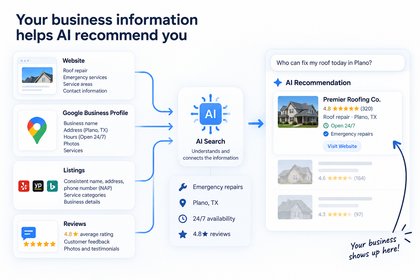
As more consumers use AI during local discovery, these questions play a greater role in helping AI tools refer to your business. According to BrightLocal’s 2026 Local Consumer Review Survey, 45% of consumers use AI platforms like ChatGPT for local business recommendations, up from 6% the previous year.
AEO builds on many practices you may already recognize from SEO for small businesses, including accurate business listings, useful website content, complete business profiles, and customer reviews.
For a small business, you can think about AEO through three questions:
- Who are you? Is your business information accurate and consistent wherever it appears online?
- What are you relevant for? Can an AI search engine clearly identify your services, specialties, locations, and the problems you solve?
- Why should AI trust the information? Do credible signals across your website, profiles, listings, and reviews support what your business says?
Those three questions help you assess your AEO presence and identify where your business information needs work.
SEO vs. AEO: What’s the Difference for a Business?
SEO, or Search Engine Optimization, helps search engines find, understand, and rank your business in traditional search engine results pages (SERPs) like Google’s. AEO focuses on making that information usable by AI answer engines when they generate direct answers and recommendations.
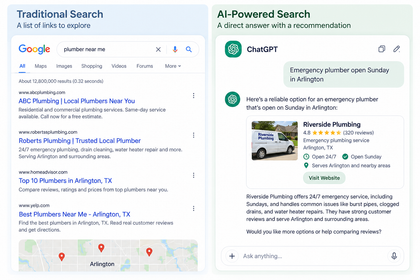
For a local business, much of the work overlaps. A clear website, accurate listings, local relevance, useful content, and strong customer reviews can support visibility across both traditional and AI engines.
| SEO | AEO | |
| Primary goal | Improve visibility and rankings in search results | Help AI platforms understand your business and potentially use it in answers or recommendations |
| Where it shows up | Google search results, local results, Google Maps, and search features such as featured snippets and the answer box | AI Overviews, chatbots, voice assistants, AI search experiences, and other answer engines |
| Core question | How relevant is this business or page to the search? | Is this business a relevant and well-supported answer to the user’s question? |
| What the owner works on | Website structure and content, local keywords, links, reviews, listings, and Google Business Profile. | Clear service and location information, question-led content, complete profiles and listings, reviews, and other information that supports what the business claims |
| Relationship | Creates much of the online foundation AEO can draw from | Builds on that foundation with more emphasis on clear answers, context, and information AI systems can interpret |
For a deeper breakdown, see how SEO, AEO, and GEO fit together.
Traditional search, Google AI Overviews, voice search, and generative AI can all draw on the same underlying business information and content. Whether you show up in any of them or whether they recommend you depends on the signals they can find about your business across the web.
Are Strong Google Rankings Enough for AI Search?
Not on their own. Strong Google visibility doesn’t automatically carry over. SOCi’s 2026 Local Visibility Index found that fewer than half of businesses leading in Google local search results also appeared in AI local recommendations. At the same time, visibility in local AI recommendations is up to 30x harder to achieve than ranking in Google local results.
Local search is becoming more specific. Someone using traditional near-me searches might type “plumber near me,” while voice searches or conversational AI queries can include details such as “emergency plumber open Sunday who serves Arlington.” AI can use those details to narrow the options before the customer starts comparing businesses. That makes brand visibility increasingly dependent on whether a tool can identify your business as a strong match for a detailed request.
That changes what visibility means for a local business. For business owners, the goal is to make key details such as service areas, specialties, and availability easy to identify when customers ask specific questions.
AEO ultimately helps AI search engines answer one commercially important question more clearly: Is this business a good match for this particular customer request?
See how your business stacks up in AI against competitors
Get a free AI-powered report showing where you rank online and what to fix first.
Six Tips to Help AI Recommend Your Small Business
Start with your own website. BrightLocal’s 2024 analysis of ChatGPT sources found that business websites make up 58% of all local search sources in ChatGPT. This is followed by business mentions (27%) and directories (15%). Unlike established discussions around Google SEO ranking factors, there’s no universal formula for AI engine recommendations. Focus on giving AI search engines clear, consistent, and credible information they can use when considering your business for a recommendation.
So, what information do you need to expose to AI platforms so they can identify your business as a relevant option for your customers?
The six tips below will help your business gain more AI visibility:
1. Be Specific About the Service You Offer
AI search engines need clear, specific information about the services your business provides. This helps them determine whether your business actually offers what a customer is asking for, particularly when the request goes beyond a broad category such as “plumber” or “dentist.”
For example, a med spa may offer Botox, laser hair removal, chemical peels, and microneedling. If its website and profiles only describe the business as a “med spa,” less information connects it to someone specifically looking for microneedling.
Make individual services easy to identify across your:
- Service pages
- Business profiles and listings
- Website FAQs
- About and location pages
Be specific about specialties too. “Roof repair” tells an AI tool something useful; “24-hour emergency roof repair” tells it much more about the searches your business could be relevant to.
2. Describe the Geographic Area You Serve
AI search engines need a clear picture of the geographic area your business serves. Location information helps them determine whether your business is actually available to a customer asking for a service in a particular town, neighborhood, or region.
For example, a roofer may need to clearly list every area it serves beyond its home town.
Support that information with accurate addresses where applicable, defined service areas on your business profiles, and useful location pages for markets you actively serve.
3. Structure Your Content for Answer Engines
Structure your website content so answer engines can quickly match a customer’s question with the right answer. Use clear headings, lead with a direct answer, then follow with specific details that establish your service, location, availability, and other relevant facts.
For example:
Do you offer emergency plumbing in Arlington?
Yes. ABC Plumbing provides 24/7 emergency plumbing throughout Arlington for burst pipes, major leaks, and other urgent repairs. Our licensed technicians typically arrive within 90 minutes, including on weekends and holidays.
This structure gives AI search engines a clear, self-contained answer with the service, location, availability, and problems handled.
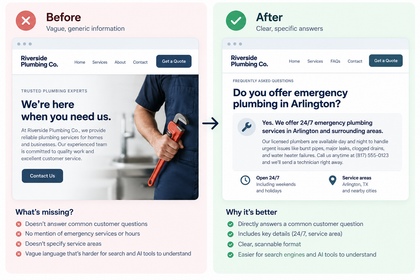
Build these sections around questions your customers actually ask before booking. Look at calls, conversations your technicians have on the job, and queries in Google Search Console.
Turn common customer questions such as “Do you handle the permit?” or “Which areas do you serve?” into clear headings with direct answers. Use these queries for a content gap analysis to find high-intent questions your website doesn’t answer clearly.
Be specific wherever possible. Name the services you provide, cities you cover, hours you operate, relevant pricing or timelines, and any important limitations. Avoid vague descriptions that require the reader or an AI platform to work out what you mean.
Keep each page focused by grouping related questions by service or location, leading with key information, and keeping answers up to date.
4. Label Your Business Details with Schema Markup
Schema markup adds machine-readable labels to your website so search engines and AI tools can interpret key information more precisely. It is a form of structured data embedded through HTML tags or code that identifies details such as your business name, address, hours, services, and other page content.
FAQ schema identifies questions and answers on a page, while other schema types can describe local businesses, services, reviews, and more. Schema can help machines interpret your page more clearly, though it doesn’t guarantee inclusion in AI-generated answers, Google AI Overviews, or featured snippets.
You don’t need to write this code yourself. Many website builders for small businesses support common schema types, while a developer or done-for-you service can handle more advanced implementation.
5. Keep Your Details Consistent Across Platforms
Your core business details should match wherever they appear online. AI platforms cross-check key information across other consumer-facing platforms and social media, including Yelp, Facebook, Google Business Profile, Angi, LinkedIn, and Better Business Bureau.
Conflicting details make it harder to establish which information is current and accurate.
According to SOCi’s index, as reported by Search Engine Land, only 68% of business contact information on ChatGPT and Perplexity matched the corresponding Google Business Profile information.
Pay particular attention to your:
- Business name
- Address
- Phone number
- Opening hours
- Service areas
- Business categories
These details should tell the same story across your website and the major profiles customers use to find you. Business listings management software can make it easier to keep these details synchronized across supported directories.
6. Build Trust Through Customer Reviews
Reviews are authentic trust signals as they provide independent evidence of people’s experiences with your business. They give AI tools context about your business’s reputation, service quality, and customer experience.
That context can be particularly useful for detailed searches. For example, a review mentioning that a plumber arrived within an hour for a Sunday leak contains information relevant to a request for an emergency plumber available on weekends.
Reviews are also central to how customers evaluate local businesses themselves. According to BrightLocal’s 2026 Local Consumer Review Survey, 97% of consumers read reviews for local businesses.
Make review requests part of your regular customer follow-up after an appointment or completed job. No time, or you feel uncomfortable asking? Consider automated review requests, so they happen consistently. If reviews come in across several platforms, use review management software to monitor and respond from one place.
Want an SEO and AEO Checklist for Small Businesses?
Download a free step-by-step checklist on how to get recommended in Google and AI search engines.
Should You Manage AEO Yourself?
For a small business with stable information, one person may be able to own that AEO process and schedule regular checks. Solid online marketing knowledge helps, but it’s not a must-have. Most of the work is upkeep: listings need checking, reviews need responses, profiles need updating, and website content needs to reflect your current services and locations.
As you grow your small business, the workload grows quickly, especially with multiple locations, service areas, profiles, and directories to maintain.
Managed support may be worth considering when:
- Search and profile updates regularly get pushed down the to-do list.
- You operate across several locations or service areas.
- No one on your team has clear ownership of online visibility.
- Reviews, listings, or website updates frequently fall behind.
- You need help managing both traditional and AI search visibility.
Thryv® Search Boosts provides expert-managed SEO and AEO support as part of the broader Thryv Growth Platform. Thryv’s team manages your website, local, and digital marketing to support visibility across traditional search and newer AI experiences. At the same time, the broader Thryv Growth Platform provides digital marketing software for small businesses to support customer acquisition and management.
K&L Roofing saw the impact of improving its search presence after working with Thryv on its website and SEO. The company moved from page five to page one on Google for its primary Maryville, Tennessee service area in under four months and later expanded into Knoxville while maintaining its local search presence.
For an owner already balancing customers, employees, and day-to-day operations, AEO adds another ongoing responsibility. The practical question is whether your business has the time and ownership needed to maintain it properly. If not, expert-managed support can take that work off your team’s plate.
Your Next AEO Steps: Where to Start, When to Get Help
Work on the six tips listed above. Start with your own website, since it carries the most weight and you can control it directly. Then, make your key information clear across all listings, profiles, directories, and other places where your business is mentioned.
AEO isn’t one-and-done as hours change and services expand. You can manage this work in-house if you have the time and expertise to keep everything up to date. If not, bring in an AEO expert. Instead of wondering whether customers can find you in AI search, take a more active role in how your business appears.
Are You Ready to Hand This to an AEO Expert?
See how Thryv’s team manages the website, listings, and reviews, so your business is easier for Google and AI search engines to recommend.
FAQs About Answer Engine Optimization (AEO)
Make your content easy for AI platforms to understand and retrieve. Build service pages around real customer questions, answer them directly, and clearly state your services, locations, hours, and availability. Use descriptive headings and structured content, so important details are easy to identify. Start with your highest-priority services and locations, then apply the same approach across the rest of your website.
Yes. Customer reviews provide third-party information about your reputation and customers’ experiences with your services. Details such as review volume, recency, ratings, and written feedback can provide useful context for AI-powered search. Encourage customers to leave genuine reviews after completed jobs and respond regularly. Reviews that mention specific services or experiences can also reinforce information AI platforms encounter elsewhere about your business.
Yes. Conflicting information can make it harder for AI platforms to determine which details about your business are accurate and up to date. Keep the basics consistent: business name, address, phone number, website URL, hours, services offered, business location, and the location(s) you serve. Keep them updated across your online presence.
You can handle many AEO fundamentals yourself, including updating profiles, correcting listings, requesting reviews, and improving website answers. The ongoing commitment is usually the bigger consideration. Someone needs to check that information stays accurate as your business changes. Expert support can make sense when no one has time to own that work, or you’re managing multiple locations, profiles, and channels.
AEO costs depend on how much work you manage yourself and how much you outsource. Updating profiles, requesting reviews, and improving website content may primarily require your time. Costs increase when you add listings software, review management, content support, technical work, or managed SEO/AEO services. Compare options based on the work included, the time they save your team, and how they’ll measure results.