
AI Search Optimization: How Small Businesses Can Get Found Online
Try Thryv for FreeBy Rebecca Riserbato, Small Business Expert
Updated October 1, 2026 · 33 min read
Key Takeaways
- AI is changing how customers discover businesses, but traditional SEO fundamentals still matter.
- AI search optimization helps search engines and AI systems better understand what your business does, who you serve, and why customers should trust you.
- Your website should clearly explain your services, locations, expertise, and answers to common customer questions.
- Original, experience-based content can help your business stand out from generic AI-generated information.
- Your website, business listings, reviews, and social presence all contribute to your broader online visibility.
- AI can help small businesses research, create, optimize, repurpose, and measure marketing content.
- The goal isn’t to market for AI. It’s to use AI to create a better, more connected experience for your customers.
When someone needs a plumber, landscaper, accountant, or salon, they don’t always start with a traditional Google search anymore.
They might ask an AI-powered search engine, use Google’s AI features, turn to ChatGPT or another AI tool, or search with a conversational question like:
“Who’s the best HVAC company near me?”
Or:
“What should I look for when hiring a local roofer?”
The way customers discover businesses is changing.
But that doesn’t mean small businesses need to throw out everything they know about SEO.
In fact, many of the fundamentals that help your business get found in traditional search still matter. The difference is that search is becoming more conversational, and AI systems are getting better at understanding information, connecting sources, and generating answers.
That’s where AI search optimization comes in.
AI search optimization isn’t about stuffing your website with keywords or trying to create content specifically for a chatbot. It’s about making your business easy to find, understand, and trust across the places customers search.
For small businesses, that means creating useful website content, answering real customer questions, maintaining accurate business information, building credibility through reviews, and using AI strategically to make your marketing more effective.
What Is AI Search Optimization?
AI search optimization is the process of making your website and online presence easier for search engines and AI-powered search tools to understand, evaluate, and surface.
Traditional SEO focuses on helping pages appear in search results for relevant searches.
AI search adds another layer.
Instead of simply matching a search query with a webpage, AI-powered search experiences can interpret a more complex question and combine information from multiple sources to generate an answer.
That means your business needs to communicate more than a list of keywords.
Your website should clearly explain:
- What your business does
- What products or services you offer
- Where you serve customers
- Who your services are for
- How your process works
- What customers can expect
- What makes your business different
- Why customers should trust you
Think of it this way:
SEO helps search engines find your business. AI search optimization helps them understand it.
Comparing SEO vs. AEO. vs. GEO
| SEO | AEO | GEO | |
|---|---|---|---|
| Goal | Rank prominently for relevant searches | Be selected as a direct answer | Be understood, cited, or recommended by generative AI |
| Where you appear | Search results and local results | Direct answers, featured snippets, voice results, and AI search | Generative AI responses, AI citations, and recommendations |
| One thing to get right | Make your website relevant and authoritative | Answer customer questions clearly and directly | Build a clear, consistent, credible presence across the web |
And you don’t need to abandon SEO to prepare for AI search. Google says its generative AI search features continue to rely on many of the same foundational SEO practices used in traditional Search. Its current guidance also emphasizes helpful, original information rather than commodity content.

How AI Is Changing Small Business Marketing
AI search is only one part of a much bigger change in marketing.
AI is influencing how customers discover, evaluate, and interact with businesses.
That creates a new opportunity for small businesses.
Instead of thinking about AI as another marketing channel you need to master, think about it as a layer that can improve the marketing work you’re already doing.
For example:
Before:
A customer searches “emergency plumber near me.”
Now:
A customer might ask an AI-powered search tool which local plumbers offer emergency service, compare options, and then visit a business website or contact the recommended company.
That means your business needs to provide useful information at multiple points in the customer journey.
Your website should explain your services.
Your listings should provide accurate business information.
Your reviews should reflect real customer experiences.
Your content should answer questions.
And your marketing should give customers a reason to choose you.
AI search is part of a bigger customer journey
Think about AI marketing as a connected process:
Get discovered → Get understood → Build trust → Win the customer → Keep learning
AI can support each stage.
It can help identify the questions customers are asking, turn those questions into content, personalize communications, identify opportunities, and analyze what’s working.
This is an important shift for small businesses.
The goal isn’t simply to rank in AI search.
The goal is to build an online presence that makes your business easier to discover, easier to understand and easier to choose.
And that’s where your existing marketing strategy and AI strategy start to overlap.
5 Ways to Optimize Your Website for AI Search
1. Make it obvious what your business does
Start with the basics.
A search engine or AI system shouldn’t have to guess what your business offers.
Your homepage and service pages should clearly explain what you do using natural language your customers understand.
For example, a home services business might say:
“We provide residential HVAC repair, maintenance, and installation throughout Bellevue, Kirkland, and surrounding areas.”
That’s more useful than a vague headline such as:
“Comfort You Can Count On.”
You can still use creative messaging. Just make sure the practical information is easy to find.
Check your website for these basics:
- Business name
- Primary services
- Products or specialties
- Service areas
- Hours
- Contact information
- Pricing or pricing guidance when appropriate
- What makes your business different
- Clear next steps for customers
The easier your business is to understand, the easier it is for customers and search systems to connect your business with relevant searches.
2. Answer the questions your customers actually ask
One of the simplest ways to improve your content is to stop guessing what customers want to know.
Listen to them.
What questions do customers ask before booking?
What do they ask when they call?
What comes up during an estimate?
What questions appear repeatedly in reviews, emails or social comments?
Those questions are content opportunities.
For example, a roofing company might answer:
- How often should a roof be inspected?
- How long does a roof replacement take?
- What are signs I need a new roof?
- How much does roof repair cost?
- Can a roof be repaired instead of replaced?
A dentist might answer:
- How often should I get a dental cleaning?
- What happens during a dental exam?
- How long does a filling take?
- When should I schedule a wisdom tooth consultation?
A landscaping business might answer:
- When is the best time to aerate a lawn?
- How often should I mow my lawn?
- How much does lawn care cost?
- What plants grow well in my area?
These aren’t just SEO keywords.
They’re questions from potential customers.
Make the answer easy to find
Put the direct answer near the top of the relevant section. Then provide additional context, examples, or helpful details.
This creates content that’s useful for people first while giving search engines and AI systems clear information to interpret.
3. Show what makes your business an expert
AI can generate a generic answer to almost any question.
That’s exactly why generic content isn’t enough.
Your advantage as a small business is firsthand experience.
If you’re a plumber, you know which plumbing problems customers commonly overlook.
If you’re a landscaper, you know which plants actually thrive in your region.
If you’re an accountant, you understand the questions business owners ask during tax season.
Use that knowledge.
Instead of publishing:
“10 Plumbing Tips Every Homeowner Should Know”
you could create:
“5 Plumbing Problems We See Most Often in Older Seattle Homes”
Instead of:
“How to Maintain Your Lawn,”
try:
“How We Recommend Preparing Pacific Northwest Lawns for Summer.”
The second example is more specific because it’s based on real-world experience.
That’s valuable to customers and helps differentiate your content from the countless generic answers AI can already produce.
Google’s current guidance for generative AI search emphasizes creating unique, useful, non-commodity content rather than simply producing more content.

How to Jump-Start Small Business Growth with AI
Free Guide
How to Jump-Start Small Business Growth with AI
Discover how to use AI to make smarter decisions, streamline your marketing, and grow more efficiently — without adding complexity. This practical guide breaks down what AI really means for your business and shows you how to apply it to improve customer engagement, uncover insights, and scale with confidence.
4. Keep your online information accurate and consistent
Your website isn’t the only place customers and search systems learn about your business.
Your information may also appear on:
- Google Business Profile
- Online directories
- Review sites
- Social media
- Industry websites
- Local publications
- Maps and navigation platforms
Make sure the important details match.
Your business name, phone number, website, hours, location and services shouldn’t be different from one platform to another.
This is particularly important for local businesses.
If your website says you’re open until 7 p.m., but another listing says 5 p.m., you’ve created confusion for both customers and the systems trying to understand your business.
Don’t forget reviews
Reviews can also help communicate what your business does and what customers value.
Pay attention to the language customers naturally use.
If customers repeatedly mention “same-day water heater repair,” “friendly technicians,” or “emergency plumbing,” those phrases can reveal what your business is known for.
That information can help inform your website copy, FAQs, service descriptions, and broader marketing strategy.
5. Use AI to make your marketing more effective
AI search optimization shouldn’t exist in a silo.
The same AI technology helping change how customers search can also help you improve the work behind your marketing.
Small businesses can use AI to:
- Brainstorm content topics
- Turn customer questions into content ideas
- Identify gaps in website content
- Draft and personalize marketing messages
- Repurpose a blog into social posts
- Summarize marketing performance
- Identify trends in customer feedback
- Automate repetitive marketing tasks
- Help prioritize marketing opportunities
The key is to use AI as a marketing assistant, not a replacement for your expertise.
For example, instead of asking an AI tool:
“Write a blog about roof maintenance.”
Give it information from your business:
“Here are the five roof problems we see most often in homes over 20 years old. Create an educational article that explains the warning signs homeowners should watch for.”
The second approach gives AI something valuable to work with:
your experience.
That human input helps make AI-assisted marketing more specific, useful and credible.
A Simple AI Marketing Strategy for Small Businesses
You don’t need to use AI for everything.
Start by connecting AI to the marketing work you already do.
A simple framework is:
Listen → Create → Optimize → Repurpose → Measure
1. Listen
Start with your customers.
Look at:
- Customer questions
- Reviews
- Search queries
- Website behavior
- Sales conversations
- Common objections
- Frequently requested services
These sources can tell you what your audience actually wants to know.
2. Create
Turn those insights into useful marketing.
AI can help you brainstorm:
- Blog topics
- FAQs
- Website copy
- Social posts
- Email ideas
- Video scripts
- Service-page content
For example, if customers constantly ask whether you offer same-day service, that’s not just a sales question.
It’s a content opportunity.
Create a service page that clearly explains your same-day availability, service area, scheduling process, and what customers should expect.
3. Optimize
Don’t publish the first AI-generated draft.
Add your expertise.
Check the facts.
Add examples.
Make the language sound like your business.
Include location-specific information when relevant.
Link to related pages.
Make the answer useful to a real customer.
This is where human judgment matters most.
4. Repurpose
One useful piece of content doesn’t have to live in one place.
A single article could become:
- Several social posts
- An email
- A customer FAQ
- A short video
- Website copy
- A sales resource
AI can help you adapt the original content for different formats while keeping the core message consistent.
5. Measure
Finally, look at what’s working.
Don’t measure success only by rankings or traffic.
Depending on your business, you might track:
- Website visits
- Calls
- Form submissions
- Appointment requests
- Leads
- New customers
- Reviews
- Revenue
The goal is to understand which marketing efforts are helping your business grow.
Why This Matters Now
AI adoption among small businesses is no longer a future trend.
Thryv’s 2026 AI & Small Business Adoption Report found that 66% of small businesses now use AI, up from 55% the previous year. Among AI users, 70% report increased revenue, 55% report reduced costs, and 83% say AI saves them time.
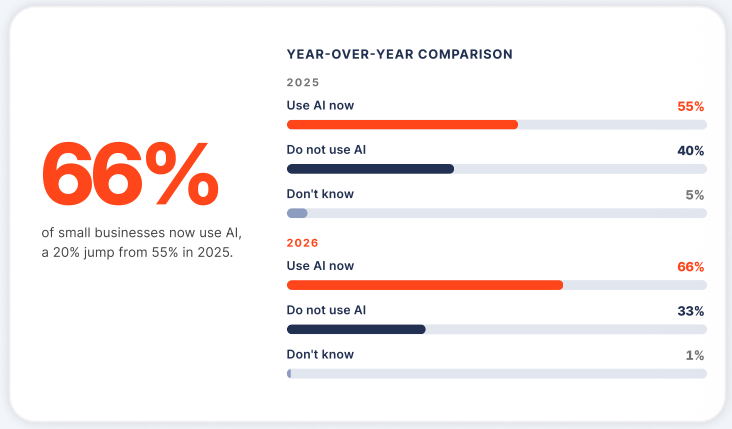
At the same time, nearly 70% of owners say they need more AI skills or training.
That creates an important distinction:
Using AI isn’t the strategy. Knowing where and how to use it is.
The businesses that get the most value from AI aren’t necessarily the ones using the most tools.
They’re the ones connecting AI to real business needs.
That might mean using AI to:
- Get discovered by more customers
- Create better content
- Respond more effectively
- Save time on repetitive marketing work
- Understand what’s working
- Make smarter marketing decisions
AI search is one piece of that larger strategy.
Common AI Search Optimization Mistakes
Trying to write for AI instead of people
Your customers are still the audience.
Don’t fill pages with awkward phrases because you think an AI system might recognize them.
Write naturally and answer questions clearly.
Publishing large amounts of generic AI content
More content isn’t automatically better.
If an AI tool could create the exact same article for hundreds of businesses, look for ways to make yours more specific.
Add original insights, customer questions, examples, data and firsthand expertise.
Ignoring local information
For many small businesses, being found means being found locally.
Make your location and service areas clear throughout your online presence.
Forgetting the rest of your online presence
Your website is important, but it isn’t your entire digital footprint.
Customers may discover you through search results, maps, reviews, social media or other websites.
Keep those touchpoints accurate and consistent.
Treating AI search as a one-time optimization
Search will continue to change.
Instead of trying to “optimize for AI” once, make content reviews part of your regular marketing routine.
Review your most important pages periodically and ask:
- Is this information still accurate?
- Are customers asking new questions?
- Have our services changed?
- Can we add a better example?
- Are there opportunities to improve clarity?
- Is there anything our competitors are answering that we’re not?
Small improvements can add up.
Try the New Thryv Experience
See what’s new — and why it gives your business an edge.
Make Your Business Easier to Find Online
AI is changing how people search, but you don’t need to become an AI expert to keep up.
Start with what you already know about your customers.
Listen to their questions. Answer them clearly. Share your experience. Keep your information accurate. Use AI to make your marketing more efficient.
Then connect those efforts across your online presence.
The goal isn’t to create a website designed for machines.
It’s to create a better online presence for your customers, one that search engines and AI systems can understand, too.
And as AI becomes part of more stages of the customer journey, the opportunity goes beyond getting found.
It’s about using AI to help your business get discovered, connect with customers, work smarter, and grow.

Small Business SEO & AEO Visibility Checklist
Optimize your business for search engines, AI answers, and zero-click discovery. Use this step-by-step checklist to improve visibility, strengthen trust signals, and turn online searches into real customer inquiries.

Ready to put AI to work for your business?
Thryv brings AI-powered marketing and business tools together to help small businesses get found online, attract customers, and spend less time managing repetitive marketing tasks.
See how Thryv can help you put AI to work.
FAQs on AI Search Optimization
AI search optimization is the process of creating and organizing your website and online presence so search engines and AI-powered search tools can better understand, trust, and surface your business information. It builds on traditional SEO fundamentals, including useful content, clear website structure, relevant information, and accurate business details.
Start with the fundamentals. Clearly explain what your business does, the services you offer, and where you serve customers. Answer common customer questions, publish useful and original content, maintain accurate business listings, and build trust through reviews and other credible information.
No. SEO remains an important foundation for AI-powered search. Google’s current guidance says its generative AI search experiences continue to rely on fundamental SEO practices. The opportunity is to combine those fundamentals with clear, useful, and experience-based content that answers customers’ questions.
AI can help with research, brainstorming, drafting, and repurposing content, but businesses should review and improve AI-generated content before publishing it. Add firsthand expertise, accurate information, examples, and insights that make the content genuinely useful to your customers.
You don’t need special AI markup or an llms.txt file to appear in Google’s AI search features. Focus first on the fundamentals: crawlable pages, useful content, clear information, strong website structure, and accurate business details.