Key Takeaways
- Audit your online presence before Q4 to identify website, marketing, and customer experience gaps.
- Keep business listings accurate and consistent to improve local business visibility and make it easier for customers to find you.
- Build review momentum now so your business has fresh customer feedback when holiday shoppers start searching.
- Use automation for repetitive follow-up, including lead nurturing, appointment reminders, and review requests.
- Organize and segment customer contacts so your fall and holiday marketing reaches the right audiences with more relevant messages.
- Prepare for AI-powered search by keeping your business information, website content, and reviews clear, accurate, and consistent across the web.
September is the calm before the holiday rush for many small businesses. It is also one of your last good opportunities to make improvements before fall demand picks up.
Instead of waiting until your calendar fills up, use September to get your marketing, customer experience, and operations ready for a busier Q4.
A strong online presence management strategy can help you do that. When your website, listings, reviews, marketing, and customer communications are working together, it becomes easier for customers to find your business, decide to contact you, and stay connected after they do.
Use this September business growth checklist to identify what needs attention now, before the holiday rush begins.
Your September Business Growth Checklist
- Audit your website and marketing performance
- Refresh your listings and local search presence
- Build review momentum before holiday shoppers arrive
- Automate lead nurturing and customer follow-up
- Clean up your CRM and segment holiday audiences
You do not have to tackle everything at once. Start with the area that has the biggest gap and work your way through the list.
1. Audit Your Website and Marketing Performance
Before increasing your holiday marketing, take a look at how your current strategy is performing.
Your website, search presence, social media, advertising, and email campaigns all contribute to your online presence. But if you do not know which channels are bringing in traffic, leads, and customers, it is difficult to know where to invest more during Q4.
Start with a quick website and marketing audit.
Check your website
Ask yourself:
- Is your business information current?
- Are your products and services clearly explained?
- Can customers easily call, book, request a quote or make a purchase?
- Are your calls to action easy to find?
- Does your website work well on mobile devices?
- Are your seasonal offers easy to find?
- Does the site clearly explain what makes your business different?
Your website is often one of the first places customers go after discovering your business. It should make it easy for them to understand what you offer and take the next step.
Review your marketing
Look at your recent performance across:
- Organic search
- Paid advertising
- Social media
- Email and text campaigns
- Website traffic
- Lead generation
- Customer conversions
Then ask a simple question: What should I do more of in Q4?
You may find that one channel is consistently generating leads while another is taking time without producing much return. That insight can help you focus your holiday budget and time where they are most likely to make a difference.
Reporting software can help bring marketing performance into one place, making it easier to see what is driving activity and where you may need to make adjustments.

September Quick Win
Search your business name online and visit your website as if you were a new customer. Look for anything that could create friction or make it harder to contact you.
2. Refresh Your Listings and Local Search Presence
Holiday customers are not only searching for what to buy. They are searching for where to buy it.
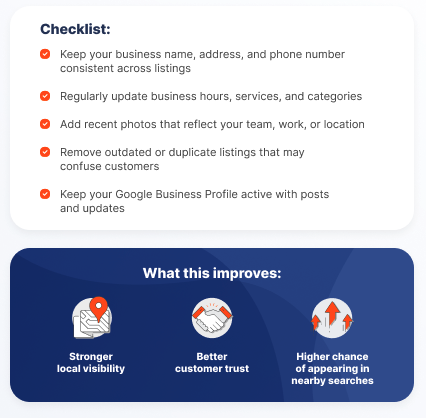
That makes accurate business listings an important part of online presence management and local business visibility.

Free Checklist: Visibility Checklist 2026
Free Guide
Free Checklist: Visibility Checklist 2026
Build a stronger online presence with a practical checklist designed to improve your visibility across search engines, maps, social media, reviews, and AI-powered search. Learn how to strengthen the trust signals that help customers find, choose, and confidently do business with you.
Imagine someone finds your business through Google, Yelp or another directory, only to see an old phone number, incorrect hours or outdated services. During a busy shopping season, that customer may simply choose another business.
Before Q4, review your:
- Business name
- Address
- Phone number
- Website
- Regular business hours
- Holiday hours
- Products and services
- Business description
- Photos
- Booking or contact information
Consistency matters. Customers should see the same essential information wherever they encounter your business.
Listing management tools can help simplify this process by allowing businesses to update information and synchronize it across multiple online listing sites.
Think beyond traditional search
There is another reason to pay attention to your digital presence before the holidays: AI visibility.
Customers are increasingly using AI-powered search tools to discover businesses, compare options, and get recommendations. Your business information needs to be clear and consistent enough for those systems to understand what you do, where you operate, and who you serve.

How to Jump-Start Small Business Growth with AI
Discover how to use AI to make smarter decisions, streamline your marketing, and grow more efficiently — without adding complexity. This practical guide breaks down what AI really means for your business and shows you how to apply it to improve customer engagement, uncover insights, and scale with confidence.
Download
That does not mean chasing every new AI ranking tactic.
Start with the fundamentals:
- Keep your business information accurate.
- Clearly describe your products and services.
- Make your location and service area easy to understand.
- Maintain a professional website.
- Build a consistent presence across relevant platforms.
- Continue earning and responding to customer reviews.
These are all pieces of a stronger online presence.
Tools that manage online listings can provide SEO and AEO strategies designed to help businesses improve visibility across search and AI results.
September quick win
Search for your business on Google, Google Maps, and other major directories. Make a list of anything that is outdated or inconsistent and prioritize those updates.
3. Build Review Momentum Before Holiday Shoppers Arrive
When customers are comparing businesses, reviews can help them decide which one to trust.
That makes September a good time to build your review momentum instead of waiting until holiday traffic is already coming in.
Look for natural opportunities to ask satisfied customers for feedback, such as after:
- Completing a service
- Finishing a project
- Delivering an order
- Completing an appointment
- Successfully resolving a customer issue
The key is consistency. Rather than relying on someone to remember to ask for a review, build the request into your normal customer process.
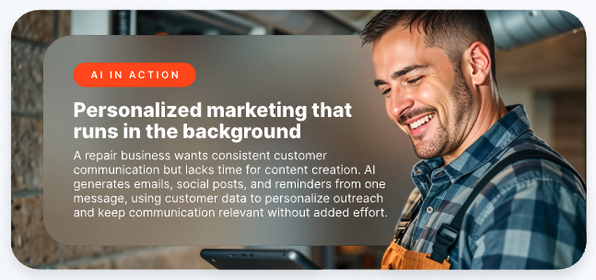
Automating review requests can make that easier. Automated review tools can send review requests after a sale while also helping businesses monitor and respond to reviews.
Reviews can also support your visibility beyond traditional search. Customer feedback can provide authentic language about your business, services, and location that helps potential customers understand what you offer.
And responding matters, too. A thoughtful response shows prospective customers that your business pays attention to its customers, not just its star rating.
September quick win: Identify the point in your customer journey when someone is most satisfied with your service and make that your standard moment for requesting a review.
4. Automate Lead Nurturing and Customer Follow-Up
More holiday demand can mean more leads.
It can also mean more opportunities for follow-up to get lost.
When your team is busy answering calls, serving customers, and managing day-to-day operations, remembering every follow-up can become difficult. Automation can help keep important communications moving without requiring someone to manually manage every interaction.
Consider automating:
New lead follow-up: Send a timely email or text after someone submits an inquiry.
Appointment reminders: Give customers a reminder before their scheduled appointment.
Post-purchase follow-up: Check in after a product or service has been delivered.
Review requests: Automatically ask customers to share their experience.
Seasonal campaigns: Send relevant promotions to specific customer groups based on their relationship with your business.
The goal is not to automate every customer interaction. It is to automate the repetitive steps, so your team can spend more time on the conversations that actually need a person.
Thryv brings marketing automation, customer management, and AI-powered insights together, so businesses can spend less time moving information between tools and more time acting on it.
This is one area where having your marketing and customer information connected can make a difference.
For example, Thryv AI Lead Insights can help identify promising opportunities, understand lead intent, and prioritize follow-up.
September quick win
Pick one repetitive follow-up task your team performs every week and look for a way to automate it before Q4.
5. Clean Up Your CRM and Segment Your Holiday Audiences
Your CRM can become especially valuable during the holiday season, but only if the information inside it is organized.
Before you start your fall and holiday campaigns, take some time to clean up your contacts.
Start by:
- Removing duplicate contacts
- Updating outdated information
- Reviewing lead and customer statuses
- Identifying inactive contacts
- Checking that important customer details are complete
- Organizing contacts into useful segments
Then consider how different groups might respond to different messages.
For example:
New leads may need more information before they are ready to buy.
Returning customers may respond well to a loyalty offer.
Past customers may need a reminder about a seasonal product or service.
High-value customers may appreciate an exclusive promotion or early access.
Inactive customers may respond to a reason to come back.
Segmentation helps you move away from sending the same promotion to everyone and toward more relevant customer communication.
It also connects back to the bigger goal of online presence management. Your online presence is not just what customers see when they find you. It includes what happens after they become a lead or customer.
With your contacts, marketing, and customer interactions organized in one place, it becomes easier to create a consistent experience from first discovery through repeat business.
September quick win
Create three customer segments you can realistically use for your fall and holiday campaigns.
How Thryv Can Fit Into Your Holiday Prep
The goal of holiday preparation is not to add more work to your plate.
It is to identify the work that needs to happen and make as much of it as possible easier to manage.
That is where having connected tools can help. Thryv brings online presence management, customer management, marketing, automation, AI insights, and reporting together so small businesses can cohesively manage more of the customer journey.
You can also use Thryv’s done-for-you Boosts when you need additional support in a specific area.
Think of Boosts as a way to fill the gaps in your holiday preparation. If you need to improve search and AI visibility, Search Boosts can support listings, SEO, and AEO. If you need more leads, Ads Boosts can help reach high-intent customers. If staying active on social is a challenge, Social Boosts can help maintain a consistent presence. And if you need a stronger online first impression, Brand Boosts can support your website, logo, and content. You do not need all four. Start with the area of your customer journey that needs the most attention and choose the support that fits your goals.
Get Your Online Presence Ready Before the Rush
The holiday season does not have to be a scramble.
September gives you time to strengthen the foundation that supports your business when demand increases: your website, listings, reviews, follow-up processes, and customer data.
A stronger approach to online presence management can help you improve your online presence, strengthen local business visibility, build AI visibility, and create more opportunities to turn searches into customers.
You do not have to fix everything at once.
Start with the biggest gap. Make one improvement this week. Then move to the next.
By the time the holiday rush arrives, you will not just be reacting to more customers. You will have a stronger system in place to help you find them, follow up with them, and keep them coming back.
September Business Growth FAQs
A: Small businesses should audit their marketing and website, update online listings, build review momentum, automate repetitive follow-up, and organize CRM contacts before holiday demand increases.
A: Start by making sure your website and online listings contain accurate, consistent information. Then focus on reviews, local search visibility, social media and customer follow-up. These elements work together to create a stronger online presence.
A: Keeping business listings accurate and consistent, maintaining a complete Google Business Profile, earning customer reviews and providing useful website content can all support local business visibility.
A: Automation can handle repetitive tasks such as lead follow-up, appointment reminders, review requests and marketing messages. This can help businesses stay responsive while their teams are managing higher customer demand.
A: Start with the fundamentals of a strong online presence. Keep business information accurate and consistent, clearly explain your products and services, maintain a professional website, build customer reviews and strengthen your presence across relevant online platforms. These signals can help AI-powered search tools better understand and recommend your business.