

Search isn’t what it used to be.
It’s no longer just about ranking on Google. Your business now shows up in AI-generated answers, map packs, voice searches, short-form videos, and social feeds — sometimes all before a customer even visits your website.
For small businesses, that shift can feel overwhelming. But it also creates opportunity. Because while big brands chase complexity, small businesses can win by being clear, consistent, and structured.
Here’s how to modernize your SEO strategy for 2026 — and turn visibility into real revenue.
SEO Tips for Small Business Websites
1. Create AI-Ready Content That’s Structured for Answers
2. Treat Social Media as a Search Amplifier
3. Create valuable content (and keep it updated).
4. Ensure your website is mobile-friendly and fast.
5. Earn high-quality backlinks.
6. Encourage online reviews.
7. Strengthen Technical SEO So AI Can Trust You
8. Use schema markup.
9. Optimize Short-Form Video for Discoverability
10. Build Measurable Brand Trust Signals
11. Focus on Intent Instead of Isolated Keywords
1. Create AI-Ready Content That’s Structured for Answers.
Search engines no longer just index pages — they interpret and summarize them. AI tools scan your content looking for clear, direct answers they can surface instantly.
That means vague, keyword-stuffed pages don’t work anymore. What works is content that mirrors how real customers ask questions.
Instead of writing a generic service page about “HVAC Repair,” imagine structuring your content around what people actually type into search bars: “How much does HVAC repair cost in Dallas?” or “What are signs my AC needs repair?”
When you answer those questions clearly — ideally within the first few sentences under each heading — you increase your chances of being featured in AI summaries and voice results. Think of it this way: if a search engine had to quote your page in one paragraph, would it find a clean, concise answer?
Formatting matters more than ever. Short paragraphs. Descriptive subheadings. Natural language. AI systems prefer content that’s easy for humans to skim.
Structured data also plays a major role. Schema markup tells search engines exactly what your business offers, where you’re located, what customers think about you, and what services you provide. It’s like giving AI a labeled blueprint instead of asking it to guess.
When your website, listings, and service pages are managed in one place, it becomes much easier to keep that structure consistent — which strengthens your overall visibility.
2. Treat Social Media as a Search Amplifier.
For years, businesses treated SEO and social media as separate strategies. In 2026, that separation no longer makes sense.
Social platforms influence search in indirect but powerful ways. When someone discovers your business on Instagram or TikTok and later Googles your name, that branded search activity strengthens your authority. When your posts get shared and linked, they generate traffic and backlinks. When customers engage with your educational videos, they spend more time interacting with your brand.
Search engines notice those signals.
The smartest small businesses are now creating content once and distributing it everywhere. A blog post answering a common customer question can become a short-form video, a carousel post, an email, and a FAQ page. Each touchpoint reinforces the others.
Captions should reflect real search language. If someone might search “How long does Invisalign treatment take?” that exact phrasing belongs in your video caption and description. When social content aligns with search intent, it becomes discoverable beyond just followers.
Integration is the multiplier. When your scheduling tools, CRM, website, and social media management work together, you don’t just create engagement — you convert it.
3. Create valuable content (and keep it updated).
Creating valuable content is one of the most critical ways small businesses can improve their visibility in search results. Search engines like Google aim to show users the most relevant and helpful content for their queries, so your goal is to become a trusted resource by answering the questions your customers are already asking. This can take the form of blog posts, FAQ pages, how-to guides, or service explanations. The content should be easy to read, informative, and focused on one clear topic or keyword per page.
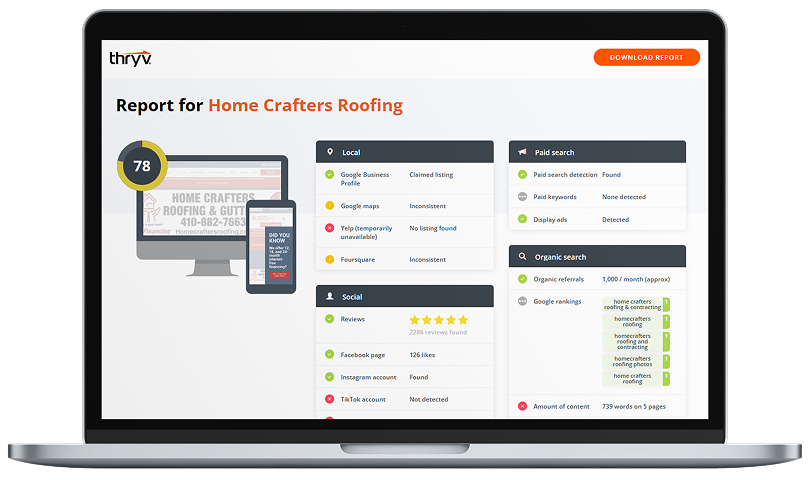
To make your content SEO-friendly, use on-page optimization techniques such as including your main keyword in the page title, URL, meta description, and within the first paragraph. Use clear headers (H1 for the main title, H2 for subtopics), and add internal links that connect readers to related pages on your site. This helps both users and search engines better understand your website structure and authority. If you don’t know where to begin, you can use Thryv’s Business Presence tool for ideas on how to improve your website engagement.
Just as important as creating new content is keeping it up to date. Search engines prioritize fresh, accurate information. If you let pages get outdated—with old stats, irrelevant references, or broken links—your rankings can drop over time. Regularly updating older pages with new insights, current data, or improved formatting shows that your site is active and trustworthy. Maintaining a steady blog schedule also signals relevance and can help you capitalize on seasonal search trends, such as “2025 summer HVAC tips” or “holiday gift ideas under $50.” When your content stays current and useful, your business stays more visible.
4. Ensure your website is mobile-friendly and fast.
Having a mobile-friendly and fast-loading website is essential for both user experience and search engine rankings. More than half of all web traffic comes from mobile devices, so if your site doesn’t look or function properly on a phone or tablet, potential customers are likely to leave, and Google will notice. That’s why search engines now prioritize mobile-first indexing, which means they look at the mobile version of your site first when deciding how to rank it.
To ensure your site works well on all screen sizes, use a responsive design. This means your website layout automatically adjusts based on the screen size it’s being viewed on—whether it’s a smartphone, tablet, or desktop. Text should be easy to read, buttons should be tappable, and images should scale properly without users needing to pinch and zoom.
Speed also matters. A slow site can frustrate users and negatively impact your SEO. Two simple ways to improve load time are to compress images and enable caching. Compressing images reduces the file size without sacrificing quality, which means they load faster. Caching is a technical process where parts of your website are temporarily stored in a visitor’s browser so they don’t have to reload every element each time they visit, making repeat visits much quicker.
You can test how your website performs by using a free tool like Google PageSpeed Insights. It shows how fast your site loads, highlights any issues, and offers specific suggestions for improvement. A fast, responsive site not only ranks better in search engines but also keeps visitors engaged and more likely to take action, whether that’s making a purchase, booking a service, or getting in touch.
5. Earn high-quality backlinks.
One of the most powerful ways to improve your search engine ranking is by earning quality backlinks. A backlink is simply a link from another website to yours. Think of it as a vote of confidence—when a trusted site links to your content, it signals to search engines like Google that your site is credible, helpful, and worth showing to others. The more high-quality backlinks you have, the more likely you are to rank higher in search results.
To build backlinks, focus on getting featured in reputable sites that align with your industry and target audience. You can partner with local bloggers, community organizations, or local news outlets to get mentioned or interviewed. These links not only help with SEO but also drive targeted traffic from people in your area. Another effective strategy is writing guest posts for relevant blogs in your industry. In exchange for your content, most sites will let you include a link back to your own website.
You can also attract backlinks by creating valuable resources that others naturally want to reference, such as original research, how-to guides, or industry statistics. When other websites cite your content as a source, they often include a link to your page. These organic backlinks gradually establish your authority and can significantly improve your visibility in search engines. In short, backlinks help search engines trust your site, and trust equals better rankings.
6. Encourage online reviews.
Online reviews play a significant role in how potential customers perceive your business, and they also impact how well you show up in local search results. Encouraging satisfied customers to leave reviews, especially on platforms like Google, helps build trust with new visitors and signals to search engines that your business is active, reputable, and providing value to your community.
Reviews are one of the most important factors in local SEO, particularly for businesses that rely on nearby customers. Google considers both the number of reviews and the overall rating when deciding where to place businesses in search results and on Google Maps. So the more positive, authentic reviews you have, the better your chances of appearing higher in local searches.
It’s just as important to respond to every review, whether it’s glowing or critical. Thanking customers for their feedback shows appreciation and professionalism, while calmly addressing negative reviews shows potential customers that you care about resolving issues. This type of engagement not only boosts your reputation but also demonstrates to Google that your business is responsive and active, thereby further enhancing your local visibility.
Tip: Thryv offers reputation management software, so you can effortlessly monitor reviews, all from a single platform.

Free Guide: Buying Software Checklist
With so many software options, we’ll help you determine which tools are right for your small business and how to choose the best ones in this free ebook.
Download
7. Strengthen Technical SEO So AI Can Trust You.
You don’t need to understand code to understand this: if your website is slow, inconsistent, or confusing, search engines hesitate to recommend it.
Technical SEO in 2026 isn’t about advanced tricks. It’s about foundational trust.
Search engines evaluate whether your site loads quickly, works seamlessly on mobile devices, and presents clear navigation. If a potential customer clicks your site from an AI summary and it takes five seconds to load, that friction works against you.
Consistency across platforms is equally important. Your business name, address, and phone number must match across directories, your website, and social profiles. Even small discrepancies can weaken local search performance.
Structured data, secure HTTPS connections, and logical internal linking are no longer “nice to have.” They’re baseline requirements for being considered authoritative.
When these pieces are managed separately across different tools, errors creep in. But when they’re centralized, maintaining accuracy becomes manageable — even for busy owners.
8. Use schema markup.
Schema markup is a type of code that you add to your website to help search engines better understand what your content is about. It’s similar to adding labels or tags to different parts of your page. Think of it as giving Google extra clues so it can display your business information more clearly in search results.
For example, if you add schema markup to show your product’s price, customer star ratings, or answers to frequently asked questions, Google can use that info to create rich results—those enhanced listings with stars, prices, or helpful snippets right on the search page. These rich results stand out more, catch people’s attention, and can increase the chances that someone clicks on your website.
Here’s an example of what it looks like in action:

9. Optimize Short-Form Video for Discoverability.
Short-form video has become one of the most powerful visibility tools available to small businesses. But many owners still treat it purely as a social media tactic.
In reality, search engines now analyze video captions, transcripts, on-screen text, and descriptions. That means your 45-second educational clip can surface in search results — if it’s structured correctly.
The difference often comes down to clarity. A video titled “Watch This!” won’t travel far. A video titled “3 Signs You Need Roof Repair in Phoenix” speaks directly to search intent.
Adding keyword-rich captions, uploading transcripts when possible, and embedding videos on relevant service pages increases discoverability. Including video schema on your website helps search engines understand exactly what the video covers.
When video answers a specific question and connects viewers to a clear next step — booking, calling, or requesting a quote — it becomes more than content. It becomes a conversion tool.
10. Build Measurable Brand Trust Signals
In 2026, rankings are heavily influenced by trust.
Search engines analyze review volume, recency, response rates, and user engagement. They evaluate whether customers stay on your site or bounce quickly. They measure whether your business information is consistent and complete.
Reviews are no longer passive feedback. They are structured data points that influence visibility. Encouraging customers to leave reviews regularly — and responding to them promptly — signals legitimacy.
Implementing review schema can allow star ratings to appear directly in search results, increasing click-through rates. But trust doesn’t stop at reviews.
User experience matters just as much. Clear calls to action. Simple booking processes. Fast load times. Transparent service information. If customers can’t quickly find what they need, search engines interpret that friction as dissatisfaction.
Trust isn’t just emotional anymore. It’s algorithmic.
11. Focus on Intent Instead of Isolated Keywords
The biggest evolution in SEO isn’t AI tools or social platforms. It’s the shift toward intent.
Instead of chasing individual keywords, successful businesses map content to customer needs. Someone searching “emergency plumber near me” is ready to book. Someone searching “why is my water pressure low?” is researching a problem. Both matter — but they require different content.
When you build pages that answer early-stage questions and connect them to high-intent service pages, you create a complete journey.
And when that journey links directly to scheduling, communication, and follow-up tools, visibility turns into revenue.
That’s where integration becomes powerful. SEO shouldn’t live in isolation. It should connect to your CRM, booking system, review management, and marketing tools — creating a seamless path from discovery to customer relationship.
The SEO Reality: Structured, Connected, and Built for Trust
SEO in 2026 isn’t about chasing algorithms.
It’s about being clear enough for AI to understand you, structured enough for search engines to trust you, and helpful enough for customers to choose you.
Small businesses that invest in structured content, social-search synergy, technical consistency, short-form optimization, and measurable trust signals won’t just rank better — they’ll convert better.
And in today’s landscape, that’s what truly matters.