


Search behavior is changing. Customers are no longer scrolling through pages of blue links and clicking multiple websites before making a decision. Instead, they’re asking direct questions in AI-powered tools and expecting immediate, summarized answers. They increasingly receive a direct response generated from multiple online sources.
This shift has introduced a new focus for small businesses: answer engine optimization (AEO). Instead of optimizing only for rankings, AEO is about optimizing for answers, ensuring your business appears in AI-generated responses and conversational search results. When done well, AEO can significantly shorten the customer decision journey by delivering clarity, trust, and credibility before a customer ever visits your website.
Market and Grow Your Business More Effectively With Thryv Marketing Center
Thryv Marketing Center helps you attract new customers to your business and shows you which marketing strategies work best for your customers so you don’t waste time and money on the wrong tactics.

What is answer engine optimization (AEO)?
Answer engine optimization (AEO) is the practice of structuring your online presence so that AI-powered search tools and answer engines can easily extract, summarize, and recommend your business in response to user questions.
Unlike traditional SEO, which focuses on ranking webpages, AEO focuses on:
- Providing clear, direct answers
- Maintaining structured and consistent business information
- Building credibility signals across the web
- Supporting conversational and question-based queries
AI search tools for local businesses pull information from multiple sources, including:
- Business listings
- Reviews
- Website content
- FAQs
- Structured data
- Social profiles
- Third-party directories
If your information is inconsistent or incomplete, you’re less likely to appear in AI-generated recommendations, even if your website ranks well.
Why AEO Matters for the Customer Journey
Answer engine optimization helps shorten the customer decision journey in several important ways:
1. Answer-first content removes friction from the buying process.
When customers find clear answers immediately, they move from research to action faster. Instead of comparing five websites, they receive a summarized response that builds confidence quickly.
2. AEO captures high-intent searches earlier in the funnel.
AI search tools often surface businesses during the question stage, before users visit multiple websites or compare competitors. If your business appears at this early stage, you shape the decision process from the start.
3. Trust built through answers leads to higher-quality leads.
Businesses that consistently provide helpful, accurate answers earn confidence before the first click or call. When a customer reaches out after seeing your business recommended in an AI response, they often arrive with stronger intent.
AEO Strategy for Small Businesses
1. Maintain consistent business information everywhere.
2. Optimize for questions, not just keywords.
3. Strengthen review signals.
4. Structure your website for clarity.
5. Prioritize speed to response.
6. Turn visibility into action.
7. Monitor emerging AI platforms.
1. Maintain consistent business information everywhere.
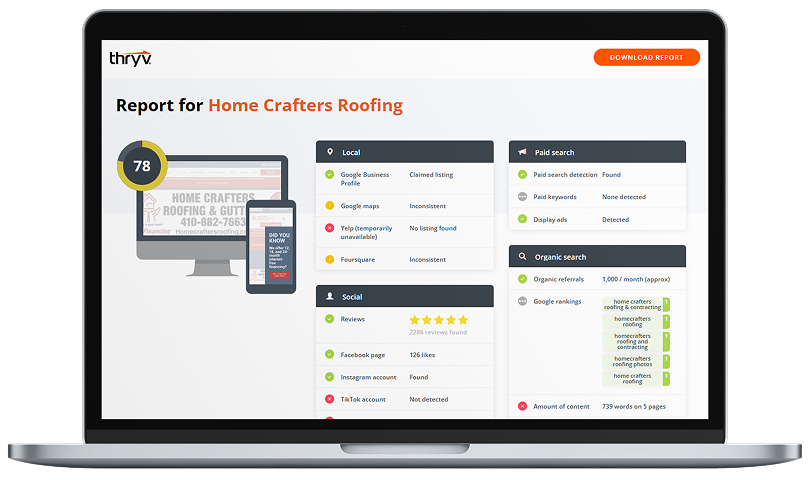
AI systems rely heavily on structured and consistent data. Your business name, address, phone number, hours, categories, and service descriptions must match across local listings, including:
- Google Business Profile
- Online directories
- Social media profiles
- Industry platforms
- Your website
Inconsistencies weaken credibility signals and reduce your chances of appearing in AI-generated answers. A unified online presence ensures customers see consistent answers wherever they search. When information is centralized and aligned across platforms, answer engines are more likely to surface your business confidently.
2. Optimize for questions, not just keywords.
AEO is rooted in how people ask questions. Instead of targeting only phrases like “HVAC repair,” consider questions like, “How much does HVAC repair cost?” or “What’s the best HVAC company near me?” Creating FAQ-style content, service explanations, and conversational headings improves your chances of being included in AI summaries.
Think in terms of clarity. AI tools favor:
- Direct answers
- Concise explanations
- Clear service descriptions
- Helpful, educational content
The more straightforward your answers, the easier they are for answer engines to extract.
3. Strengthen review signals.
Reviews play a significant role in optimizing AI search results. AI tools frequently summarize average ratings, review volume, common themes in feedback, and response behavior. Encouraging consistent, recent reviews strengthens your authority in AI-driven recommendations.
Businesses that respond to reviews professionally and maintain strong sentiment signals appear more trustworthy in answer summaries. Reviews aren’t just reputation management; they’re data inputs for AI recommendations.
4. Structure your website for clarity.
Even though AEO extends beyond your website, your site still provides foundational information.
Best practices include:
- Dedicated service pages
- Clear FAQs
- Structured headings
- Easy-to-scan content
- Location-specific information
Structured content helps answer engines understand what your business does and who it serves. Schema markup and clear formatting improve extractability, making it easier for AI search tools to accurately interpret your content.
5. Prioritize speed to response.
Shortening the customer decision journey doesn’t stop at visibility. Once AEO-driven leads convert, your response speed matters. When a customer calls or messages after seeing your business recommended by an AI tool, they’re often ready to act. Delays at this stage can undo the trust built during the search.
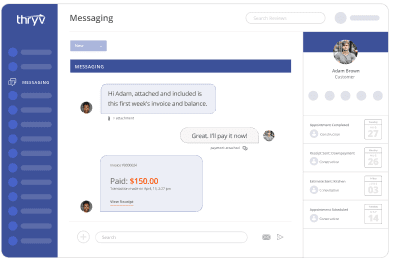
Lead management and CRM tools help businesses act quickly once AEO-driven leads convert. When inquiries, messages, and appointment requests are centralized, response time improves, and faster responses lead to higher conversion rates.
6. Turn visibility into action.
Appearing in AI search results is only the first step. Converting that visibility into real customer actions requires frictionless communication.
Customers should be able to:
- Call easily
- Message directly
- Book appointments quickly
- Leave reviews seamlessly
Reviews, messaging, and scheduling features help turn search visibility into real customer actions faster. When customers can move from recommendation to booking in just a few clicks, the decision journey shortens dramatically.
A platform like Thryv supports this process by helping small businesses maintain a unified online presence while organizing lead management and communication tools in one place. That alignment strengthens both discovery and conversion, reducing the gap between search and service.
7. Monitor emerging AI platforms.
AI search tools are evolving quickly. Small businesses should monitor conversational AI search engines, voice assistants, map-integrated AI recommendations, and industry-specific AI tools. Understanding where your business appears, and how it’s summarized, helps refine your AEO strategy over time. The goal is not to chase every new platform, but to maintain consistent, structured, and accurate information that performs well across all of them.
From Search Results to Immediate Decisions
Answer engine optimization is not replacing SEO; it’s expanding it. As AI-powered search tools become more common, customers expect direct answers, immediate clarity, and faster pathways to action. Businesses that optimize for answers, not just rankings, shorten the customer decision journey by reducing friction and building trust earlier.
When your online presence is unified, consistent, and structured for extractability, AI tools can recommend your business with confidence. And when your lead management, messaging, and scheduling systems are aligned, that visibility turns into real customer action. In the era of AI search, the businesses that win aren’t just visible. They’re answer-ready.
The Guide to AI for
Small Business
Explore real ways AI can help your small business save time, automate tasks, and drive faster, smarter growth.
FAQ
Q: What is answer engine optimization?
A: Answer engine optimization (AEO) is the practice of structuring your online presence so that AI-powered search tools can easily find, interpret, and summarize your business in response to user questions. Instead of focusing solely on ranking webpages, AEO delivers clear, direct answers that AI systems can surface in conversational search results. This includes maintaining consistent business information across listings, publishing question-based content, strengthening review signals, and ensuring your services are described clearly. For small businesses, answer engine optimization improves the chances of being recommended when customers ask AI search tools for local business suggestions.
Q: How does AEO shorten the customer decision journey?
A: AEO shortens the customer decision journey by reducing friction during the research phase. When customers receive clear, summarized answers from AI search tools, including business recommendations, ratings, and service highlights, they no longer need to visit multiple websites to compare options. This accelerates trust-building and moves customers from inquiry to action more quickly. By capturing high-intent searches early and providing structured, reliable information across platforms, an effective AEO strategy for small businesses helps convert interest into qualified leads faster than traditional browsing-based search journeys.
Q: How do you optimize content for answer engines?
A: Optimizing content for answer engines starts with clarity and structure. Businesses should create question-based headings, publish concise and direct answers, and maintain consistent business information across local listings and directories. Structured website content, clear service descriptions, updated categories, and strong review management all improve extractability for AI systems. It’s also important to maintain a unified online presence, so AI tools see consistent data wherever they pull information. AEO best practices focus less on keyword density and more on providing accurate, helpful answers that align with how customers naturally ask questions in conversational search environments.
Q: How is answer engine optimization different from SEO?
A: Traditional SEO focuses primarily on improving website rankings in search engine results pages. It emphasizes keyword targeting, backlinks, technical optimization, and content relevance to drive clicks. Answer engine optimization expands beyond rankings by prioritizing how AI search tools extract and summarize information. While SEO aims to bring users to your website, AEO aims to position your business directly within AI-generated answers. Both strategies rely on structured data and strong credibility signals, but AEO places greater emphasis on consistency across listings, review sentiment, conversational content, and overall visibility across distributed online platforms.