Winning a sale is only the beginning of the customer relationship. For small businesses, long-term growth depends more on customer loyalty than on new customer acquisition. Post-sale emails play a critical role in shaping how customers feel after a purchase.
Thoughtful follow-ups reduce buyer’s remorse, reinforce trust, and keep your business top of mind long after the transaction is complete. When paired with email marketing automation, post-sale messages become a scalable way to increase retention, lifetime value, and repeat business without adding manual work.
In 2026, customers expect timely, personalized communication. Automated post-sale workflows help small businesses deliver a strong customer experience while freeing up time to focus on day-to-day operations. Below are five essential post-sale email templates every small business should be using to strengthen relationships and drive loyalty.
5 Post-Sale Email Templates
1. The Thank-You Email
2. The Feedback Request Email
3. The Cross-Sell or Next-Step Email
4. The Referral Ask Email
5. The Anniversary or Check-In Email
1. The Thank-You Email
A thank-you email reassures customers immediately after a purchase or service, helping reduce buyer’s remorse and reinforcing that they made the right decision. This early touchpoint sets the tone for the entire relationship and strengthens customer loyalty from day one.
What to include:
- A genuine thank-you message
- Confirmation of the product or service
- Next steps or helpful details
- A friendly, human sign-off
Email Template:
Subject: Thank you for choosing [Business Name]
Hi [Customer Name],
Thank you for choosing [Business Name] for your recent [service/product]. We truly appreciate your business and the opportunity to work with you.
If you have any questions or need support, our team is always here to help. We look forward to supporting you again.
Thanks again,
[Your Name]
[Business Name]
[Contact Information]
2. The Feedback Request Email
Requesting feedback shows customers that their experience matters. It also provides businesses with valuable insights while opening the door to stronger relationships, improved service, and future reviews that build trust and visibility.
What to include:
- A short, friendly request
- Clear instructions or a link
- Appreciation for their time
- Reassurance that feedback is valued
Email Template:
Subject: We’d love your feedback, [Customer Name]
Hi [Customer Name],
We hope you’re enjoying your experience with [Business Name]. Your feedback helps us continue improving and better serve customers.
If you have a moment, we’d appreciate hearing about your experience here:
[Feedback or Review Link]
Thank you for your time—we truly value your input.
Best,
[Your Name]
[Business Name]
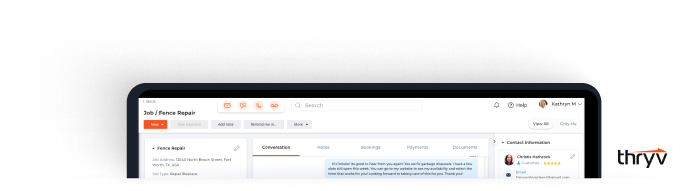
Market and Grow Your Business More Effectively With Thryv Marketing Center
Thryv Marketing Center helps you attract new customers to your business and shows you which marketing strategies work best for your customers so you don’t waste time and money on the wrong tactics.
3. The Cross-Sell or Next-Step Email
Cross-sell emails help customers get more value from their original purchase while creating natural opportunities for repeat business. When relevant and timely, these emails feel helpful rather than salesy.
What to include
- Reference to the original purchase
- A relevant add-on or next step
- Clear value explanation
- A simple call to action
Email Template
Subject: A helpful next step after your recent purchase
Hi [Customer Name],
Now that you’ve completed [service/product], many of our customers also find [related service/product] helpful for [specific benefit].
If this sounds like something you’d be interested in, feel free to learn more or reach out. We’d be happy to help.
Thanks again for choosing [Business Name].
Best,
[Your Name]
[Business Name]
4. The Referral Ask Email
Referral emails turn satisfied customers into brand advocates. Since referrals come with built-in trust, they often convert faster and cost less than other acquisition channels.
What to include
- Appreciation for the customer
- A simple referral explanation
- Who you help best
- A low-pressure ask
Email Template
Subject: Know someone who could use our help?
Hi [Customer Name],
We’re so glad you chose [Business Name]. If you know anyone who might also benefit from [service/product], we’d truly appreciate the referral.
Your recommendation means a lot to us, and we’re always happy to take great care of the people you send our way.
Thanks again for your support,
[Your Name]
[Business Name]

Email Deliverability Playbook for Small Businesses
Master email marketing with tips to boost deliverability, engagement, and automation. Download your free playbook today!
Download
5. The Anniversary or Check-In Email
Anniversary and check-in emails strengthen long-term relationships by reminding customers they’re remembered, not forgotten after the sale. These emails create natural moments to reconnect without being overly promotional.
What to include
- A personal acknowledgment (time since purchase or service)
- Appreciation for their loyalty
- A friendly check-in or offer
- A warm, conversational tone
Email Template
Subject: It’s been [time] — just checking in
Hi [Customer Name],
We can’t believe it’s already been [time period] since we first worked together. Thank you for continuing to choose [Business Name].
If there’s anything you need or if we can support you again, please don’t hesitate to reach out. We’d love to stay in touch.
Warm regards,
[Your Name]
[Business Name]
Making Post-Sale Emails Scalable With Automation
Many small business owners understand the value of post-sale communication, but struggle to execute it consistently. This is where automation becomes a competitive advantage.
Tools like Thryv help businesses automate post-sale nurturing based on customer behavior, ensuring every customer receives timely follow-ups without manual effort. Built-in email templates also make it easy to send professional, effective messages quickly, without starting from scratch.
By automating post-sale emails, small businesses can deliver personalized experiences at scale while maintaining a high standard of communication.
Turning Post-Sale Emails Into a Loyalty Engine
Customer loyalty isn’t built through a single interaction; it’s built through consistent, thoughtful communication over time. Post-sale emails help small businesses stay connected, reinforce trust, and create repeat opportunities long after the initial sale.
When powered by automation and personalization, these messages become one of the most effective customer retention strategies available. In 2026, businesses that invest in post-sale email workflows will be better positioned to retain customers, increase lifetime value, and grow sustainably.
Email Deliverability Playbook for Small Businesses
Master email marketing with tips to boost deliverability, engagement, and automation. Download your free playbook today!
FAQ
Q: Why is customer loyalty important?
A: Customer loyalty is important because repeat customers spend more, convert faster, and cost less to retain than acquiring new ones. Loyal customers are also more likely to leave reviews, refer others, and trust your business over competitors, making them a key driver of long-term growth.
Q: What is the key to customer loyalty?
A: The key to customer loyalty is consistent, positive experiences supported by clear communication. Personalized follow-ups, reliable service, and timely engagement all contribute to trust. Automation helps ensure these experiences happen consistently, even as your business grows.
Q: How to promote customer loyalty?
A: Small businesses can promote customer loyalty by:
- Following up after purchases or services
- Personalizing communication
- Asking for feedback and responding thoughtfully
- Offering relevant recommendations
- Staying in touch through automated email workflows
The goal is to stay helpful and present, without overwhelming customers.
Q: What is a customer loyalty program?
A: A customer loyalty program is a structured way to reward repeat customers for ongoing engagement. This can include discounts, exclusive offers, referral incentives, or special recognition. When paired with personalized email marketing, loyalty programs become more effective and easier to manage.