Key Takeaways
- Choose small business marketing software based on the marketing problems you need to solve, not the number of features it offers.
- Look for tools that support visibility, lead generation, customer engagement, automation and measurable results.
- AI can help reduce repetitive work and give small businesses more time to focus on growth.
- Connected marketing tools can simplify workflows and reduce the need to jump between multiple platforms.
- Choose software that can support your business as your marketing needs evolve.
Choosing small business marketing software can feel like a marketing project all on its own.
There are tools for social media, websites, SEO, online listings, reviews, advertising, and customer communication. Then there are platforms designed to bring several of those functions together.
For a small business, the goal isn’t to collect more tools. It’s to find software that makes marketing easier to manage, helps more customers find your business, and gives you a clearer path from visibility to growth.
The right small business marketing software should help you spend less time managing disconnected marketing tasks and more time reaching potential customers, building relationships, and growing your business.
Before choosing a solution, here are 11 things to consider.
Try the New Thryv Experience
See what’s new — and why it gives your business an edge.
11 Things to Consider When Choosing a Small Business Marketing Software
1. What marketing problems are you trying to solve?
Before comparing small business marketing software, start with the problems you want to fix.
Maybe your website isn’t generating enough inquiries. Customers may struggle to find you in search. Your social media may be inconsistent, or you may spend too much time following up with leads and managing reviews.
You don’t necessarily need software with the longest list of features. You need a solution that addresses the areas where your marketing is falling short.
Start by asking:
- Where are customers finding us today?
- Where are we losing potential customers?
- Which marketing tasks take the most time?
- What are we doing manually that could be automated?
- What do we want our marketing to accomplish over the next year?
Those answers give you a better starting point than comparing feature lists alone.
2. Does the software improve your online visibility?
Small business marketing starts with being found.
Customers may discover your business through Google, maps, social media, online directories, AI-powered search tools, or recommendations from other people. Your marketing software should support visibility across the places where potential customers are looking.
That may include managing business information, supporting local SEO, improving your website’s search visibility, and making your business easier for search engines and AI-powered tools to understand.
Look for software that helps you build visibility before someone becomes a lead, not just manage the lead after they find you.

Free Checklist: Visibility Checklist 2026
Free Guide
Free Checklist: Visibility Checklist 2026
Build a stronger online presence with a practical checklist designed to improve your visibility across search engines, maps, social media, reviews, and AI-powered search. Learn how to strengthen the trust signals that help customers find, choose, and confidently do business with you.
3. Does it support your website and search strategy?
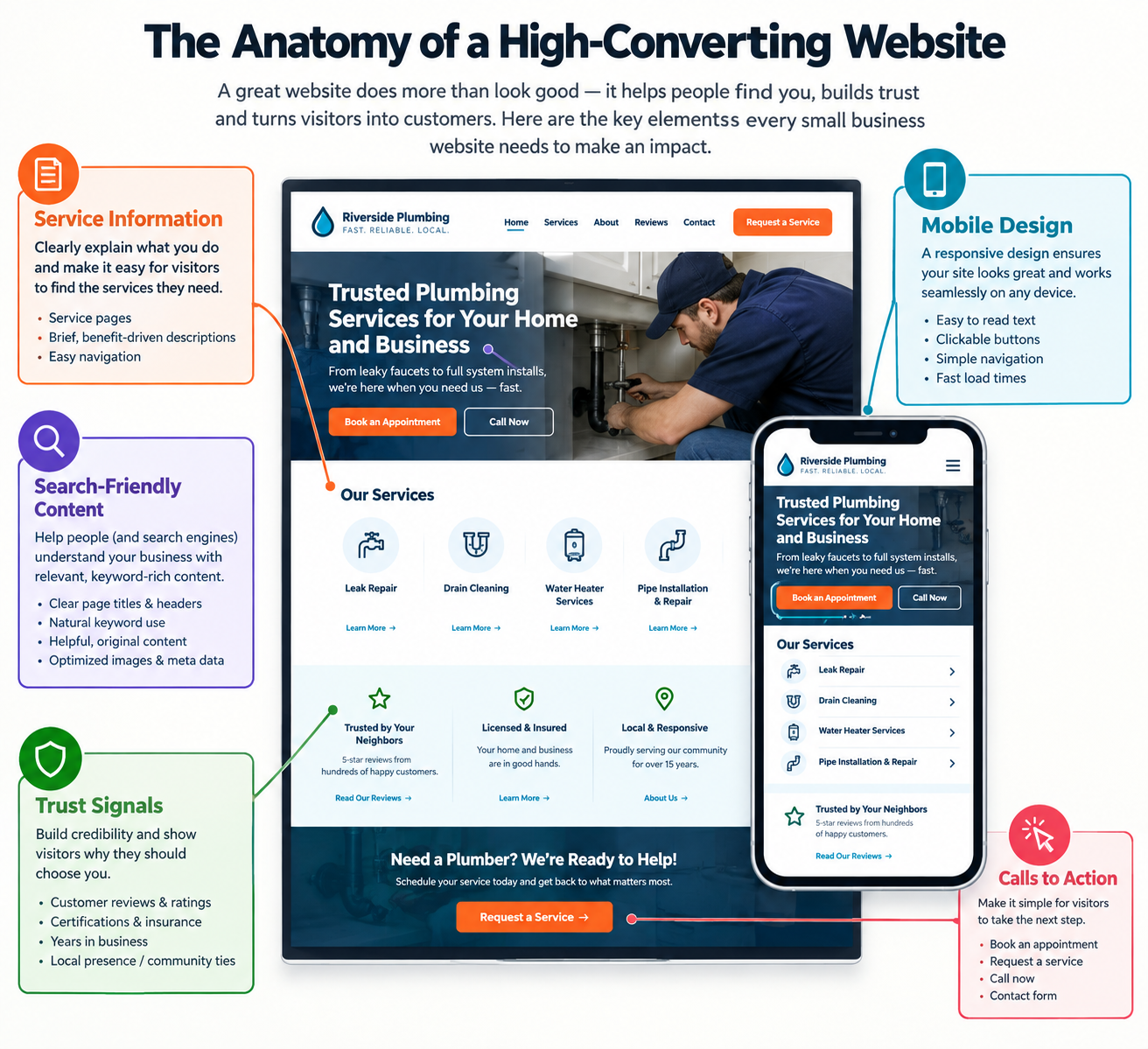
Your website is often where interested prospects go to learn more before deciding what to do next.
Small business marketing software should make it easier to keep your website useful, current, and aligned with customer needs. That includes creating or updating content, highlighting your services, supporting search visibility, and making it easy for visitors to take action.
Look for: easy website updates, mobile-friendly experiences, search-friendly content, and clear calls to action.
The best solution should help connect your website to the rest of your marketing instead of treating it as a separate project.
4. How can AI help with small business marketing?
AI can help small businesses save time, create marketing content, analyze leads, automate repetitive tasks, and identify opportunities to improve marketing performance.
But AI features shouldn’t exist simply for the sake of having AI.
The more important question is whether the software uses AI to help you accomplish meaningful marketing work more efficiently.
AI may help with:
- Creating or improving marketing content
- Identifying promising leads
- Summarizing lead or customer information
- Responding to reviews
- Generating images and creative assets
- Identifying opportunities to improve visibility
- Automating repetitive marketing activities
The best AI capabilities should feel like an extra set of hands, not another complicated system you have to manage.
5. Can it automate repetitive marketing tasks?
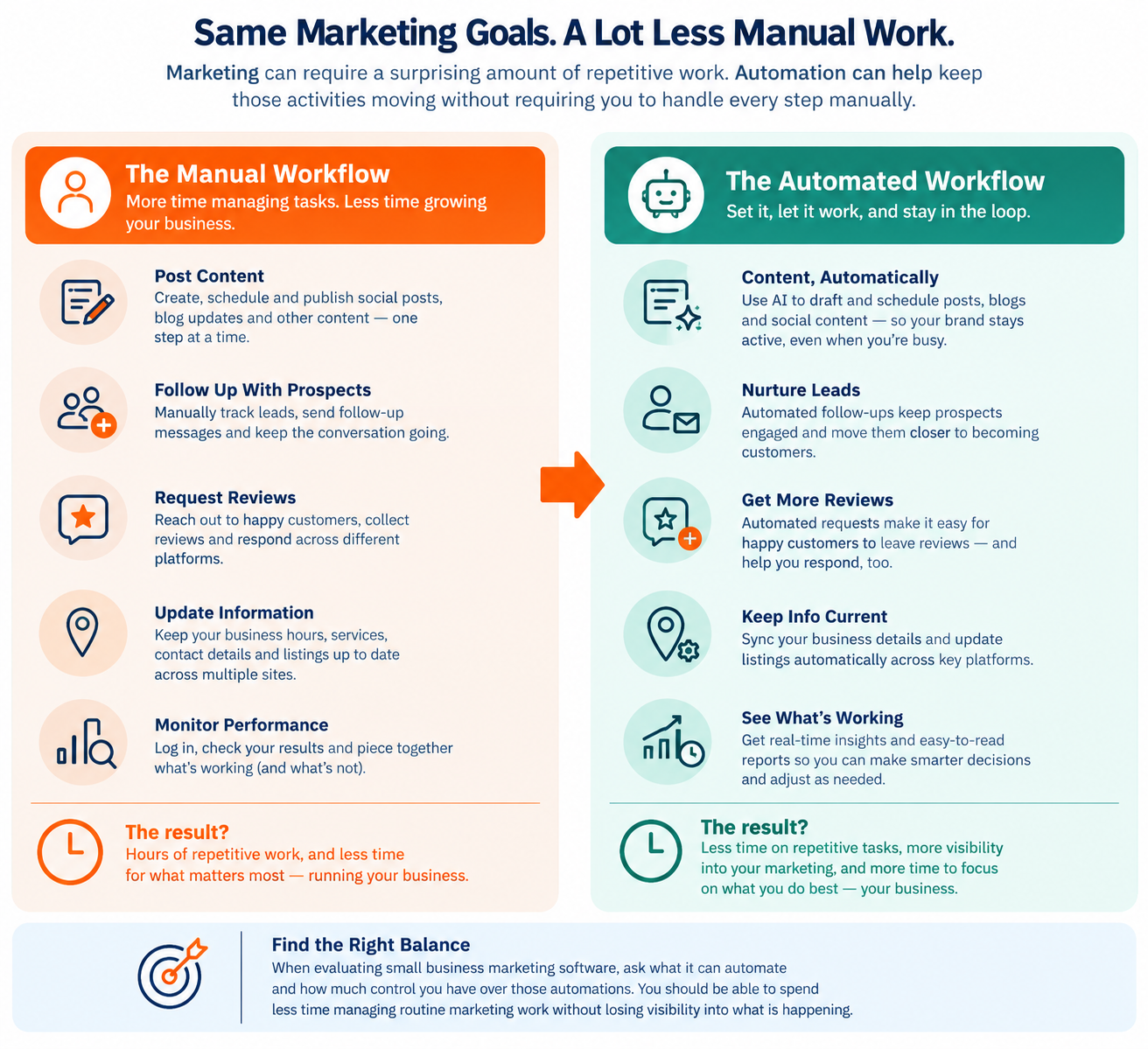
Marketing can require a surprising amount of repetitive work.
Posting content, following up with prospects, requesting reviews, updating information, and monitoring performance can quickly eat into the time you would rather spend running your business.
Automation can help keep those activities moving without requiring you to handle every step manually.
When evaluating small business marketing software, ask what it can automate and how much control you have over those automations.
You should be able to spend less time managing routine marketing work without losing visibility into what is happening.
6. Does it help manage your online presence?
Your online presence is bigger than your website.
Business listings, social profiles, reviews, search results, and other digital touchpoints all shape how customers see your business.
A marketing platform that helps you manage multiple parts of that presence can reduce the amount of time you spend jumping between tools.
Look for software that helps you maintain consistent business information, strengthen your reputation, and keep your brand recognizable across the places customers encounter it.
The goal isn’t simply to manage individual profiles. It’s to create a more consistent experience wherever customers find your business.
7. Can it help turn visibility into leads?
Getting found is only the first step.
Once someone discovers your business, your marketing needs to give them a reason and an easy way to take the next step.
Depending on your business, that might mean calling, booking an appointment, requesting a quote, submitting a form or visiting your website.
Good small business marketing software should help connect visibility with lead generation.
That means looking beyond traffic and engagement to the actions that create real opportunities for your business.
The goal isn’t simply more visitors. It’s more opportunities to grow.

Free Guide: How to Get More Leads from Social Media Ads in 2026
Turn social media ad clicks into real opportunities with a practical, AI-powered guide built for small businesses. Learn how to create more effective campaigns, build trust beyond the ad, improve your website and follow-up experience, and use AI to turn more attention into leads and customers.
DOWNLOAD
8. Does it make it easier to stay connected with prospects and customers?
Not every lead is ready to buy the moment they discover your business.
Some need more information. Others need a reminder. Some are comparing options before making a decision.
Marketing software can help you stay organized and keep communication moving without requiring you to remember every follow-up yourself.
Look for tools that support timely communication, automated follow-up, and useful context about the people reaching out to your business.
The less likely a promising opportunity is to fall through the cracks, the better.
9. Can you manage more of your marketing from one place?
There’s nothing inherently wrong with using multiple marketing tools.
The problem is when every tool operates in isolation.
One platform manages your website. Another handles social media. A third manages reviews. Another tracks advertising. Before long, you may have several logins, disconnected data, and a lot of manual work just to understand what’s happening.
A more connected approach can make marketing easier to manage.
That doesn’t mean every marketing activity needs to live in one dashboard. It means the tools you use should work together in a way that reduces duplication and gives you a clearer picture of your marketing.
10. Can you see what marketing is actually working?
Marketing is an investment. You should be able to understand what you’re getting from it.
Before choosing small business marketing software, look at the reporting and analytics it provides.
Can you see where leads are coming from? Can you identify which marketing activities are generating engagement? Can you track calls, clicks, inquiries, or other meaningful actions?
Be cautious of software that gives you lots of numbers without helping you understand what those numbers mean.
Good reporting should help answer a simple question: What should I keep doing, and what should I change?
11. Will the software grow with your business?
Your marketing needs today probably won’t be the same as they are a few years from now.
As your business grows, you may want to expand your reach, add services, advertise in additional markets, increase your content output or automate more of your marketing.
That makes scalability an important consideration.
Instead of asking only, “Does this work for my business today?” ask:
“Will this still work when my business grows?”
The right small business marketing software should give you room to start with what you need today and add capabilities as your marketing becomes more sophisticated.
What to Look for in Small Business Marketing Software
A simple way to compare your options is to look at the role each capability plays in your overall marketing strategy.
| What to evaluate | Why it matters |
| AI capabilities | Can help save time, create content and support marketing decisions |
| SEO and search visibility | Helps more potential customers discover your business |
| <Website tools | Gives prospects a place to learn more and take action |
| Automation | Reduces repetitive marketing work |
| Lead generation | Helps turn visibility and interest into opportunities |
| Reviews and reputation | Builds trust with potential customers |
| Social marketing | Helps maintain engagement and brand awareness |
| Advertising tools | |
| Analytics and reporting | Shows what’s working and where to improve |
| Integrations | Helps connect marketing activities and existing tools |
| Scalability | Gives your marketing room to grow with your business |
Don’t Choose Based on Features Alone
Small business marketing software can have every feature imaginable and still be the wrong fit for your business.
The better choice is usually the software that makes your marketing easier to manage while helping you move toward your actual business goals.
Before you make a decision, look at the bigger picture.
Get found. Can it help customers discover your business across search, AI-powered search, websites, listings and other channels?
Generate leads. Can it help turn visibility into calls, clicks, inquiries and other opportunities?
Win customers. Can it help you communicate, build trust and stay connected throughout the customer journey?
Invest smarter. Can you understand what’s working well enough to make better marketing decisions?
When those pieces work together, marketing becomes less about managing a collection of disconnected tasks and more about building a repeatable growth system.
That’s ultimately what you should be looking for: small business marketing software that helps you spend less time managing marketing and more time growing your business.
Ready to Put Your Marketing to Work?
The right marketing software can help bring more of your growth efforts together, from getting found online to creating content, managing your presence, generating leads and using AI to simplify everyday marketing work.
Thryv® is an AI-powered growth platform built to help local service businesses get found, grow, and invest smarter.
Explore a more connected approach to marketing and see how Thryv can help support your business growth.
Try the New Thryv Experience
See what’s new — and why it gives your business an edge.
FAQs on Small Business Marketing Software
A: Small business marketing software is technology that helps businesses manage and improve marketing activities such as websites, SEO, online listings, social media, advertising, reviews, lead generation, automation, and reporting.
A: Look for software that addresses your most important marketing needs, is easy to use, supports automation and AI where useful, provides actionable reporting and can scale with your business.
A: Useful features can include website tools, SEO and search visibility tools, online presence management, social media marketing, lead generation, automation, review management, analytics, advertising and AI-powered capabilities.
A: It can be. Using a more connected solution can reduce the time spent managing multiple tools and make it easier to see how different marketing activities work together. The right choice depends on your business needs, budget and existing technology.
A: AI can help automate repetitive tasks such as content creation, lead analysis, review responses and other marketing activities. It can also help identify opportunities and provide insights that support better marketing decisions.