What Is AI Search? 9 Questions and Answers for Small Business Owners
Try Thryv for FreeBy Allison Sakounthong, Small Business Expert
Updated November 19, 2026 · 33 min read
Key Takeaways
- AI search gives you direct answers and lets you ask follow-up questions instead of sorting through multiple websites.
- Use AI search to compare suppliers, research requirements, and evaluate options, but verify key details before deciding.
- Customers use AI to find local businesses, so keep your listings, reviews, and website accurate to help them discover and trust you.
You’ve probably heard about people using ChatGPT or Google to research products, compare businesses, and get answers to questions. But how can you use these tools to make better decisions for your own business, and what happens when customers use them to find businesses like yours?
AI search answers your question with one written response, usually with links to its sources, instead of only a list of pages. You can then ask follow-up questions to narrow it down. Tools like ChatGPT, Perplexity, Gemini, and Google’s AI Mode can make everyday business research easier, from comparing suppliers to understanding local requirements.
Try the New Thryv Experience
See what’s new — and why it gives your business an edge.
This guide answers nine common questions about AI search for small businesses, with practical examples you can try, tips for checking AI-generated answers, and steps to help customers find you.
AI search basics: what it is and how it works
1. What is AI search?
AI search is a type of search that writes the answer for you. Instead of showing only a list of pages, it combines information from several sources into one response, and you can keep asking follow-up questions in everyday language.
For example, a landscaping business owner could ask what types of commercial insurance they might need, then request links to relevant state requirements.
AI search focuses on finding and understanding information. Other generative AI tasks, such as drafting emails or creating marketing content, may use the same tools but serve different purposes. Some tools search the live web, while others may answer using previously learned information.
2. How is AI search different from a regular Google search?
A traditional search engine helps you find websites, business listings, maps, and other resources related to your question. You enter a question into a search bar, review the results, and open a web page to get more information. AI search can bring information from multiple sources into one answer and let you refine your research through follow-up questions.
| Traditional search | AI search |
| Shows links, listings, and other search results | Can provide a direct answer or summary |
| Often requires opening several websites | Can combine information from multiple sources |
| May require new searches to refine results | Lets you ask conversational follow-up questions |
| Useful for finding official websites and sources | Useful for researching questions and comparing information |
If you need an official permit application or a supplier’s current price list, going directly to the source is often best. For broader questions or comparisons, AI search can help you identify which sources to investigate.
Google also offers AI-powered features in its search engine, including Google AI Overviews, which summarize information in search results.

How to Jump-Start Small Business Growth with AI
Free Guide
How to Jump-Start Small Business Growth with AI
Discover how to use AI to make smarter decisions, streamline your marketing, and grow more efficiently — without adding complexity. This practical guide breaks down what AI really means for your business and shows you how to apply it to improve customer engagement, uncover insights, and scale with confidence.
3. How does AI search work?
AI search uses machine learning and natural language processing to interpret your question and generate a response. These technologies help AI systems recognize patterns in human language and understand what you’re asking.
A key part of this is semantic understanding, which helps AI recognize the meaning behind words. If you’re wondering what semantic search in AI is, it means finding information based on a question’s meaning rather than relying only on exact keyword matches.
For example, someone searching for “someone to fix a furnace that keeps shutting off” is likely looking for HVAC repair. An AI-powered search engine can recognize that intent even without the term “HVAC.”
Many generative AI tools use deep learning, a type of machine learning that relies on neural networks to process information. A neural network learns patterns from training data, which helps the tool generate relevant responses. However, that training data may not reflect the latest prices, regulations, or business information.
Some AI systems also use retrieval-augmented generation (RAG), which allows them to retrieve information from external sources before generating an answer. This can help them provide more current information and cite supporting websites, although those sources still need to be checked.
4. Which AI search tools should a small business owner try?
If you’re new to AI search, start with Google’s AI Mode. You can open it at google.com/ai or from the AI Mode tab in Google Search. If you want answers with numbered source links, try Perplexity.
After that, the best tool depends on what you’re researching. ChatGPT, Gemini, Perplexity, and Google’s AI Mode all support conversational research, but their features and approaches differ.
| Tool | Best for | Small business example |
| ChatGPT | Exploring questions, comparing options, and asking follow-ups | Compare scheduling software for a plumbing company |
| Perplexity | Researching information across websites with cited sources | Compare suppliers, pricing, and delivery options |
| Gemini | Conversational research using Google’s AI tools | Research business questions and compare service providers |
| Google AI Mode | Asking detailed questions and refining searches within Google | Research local competitors and their services |
If you’re comparing current prices or researching regulations, choose a tool with web search and links to sources. The Perplexity AI search engine emphasizes source-backed research, while ChatGPT search and Gemini can also retrieve web information.
If you’re wondering what AI Mode is in Google Search, it’s Google’s conversational search experience, which lets you ask detailed questions and follow up within the search interface.
You can explore additional free AI tools as your needs change. Keep in mind that available features, usage limits, and paid plans vary by tool.
Free Guide: The Best Free AI Tools for Small Businesses in 2026
Free Guide
Free Guide: The Best Free AI Tools for Small Businesses in 2026
Discover the AI tools that can help your small business get found online, save time, improve customer engagement, and generate more leads. This practical guide breaks down where popular AI tools can make the biggest impact and how to choose the right solutions without adding unnecessary complexity to your tech stack.
How to use AI search in your business
5. What can AI search help me do day to day?
AI search is especially useful when you need to gather information from several sources before making a business decision. Generative AI can organize findings into comparisons or summaries, helping you review options faster.
According to the U.S. Chamber of Commerce’s 2026 report, 66% of small businesses use AI, up eight percentage points from 2025.
You can start with a question you’re already researching. Here are five practical ways to use AI search:
| Task | Example AI search prompt | What to double-check |
| Compare suppliers | “Compare three HVAC parts suppliers serving Atlanta. Include delivery options, available pricing, and links to each supplier.” | Prices, stock, and delivery times |
| Research permits | “What permits might a roofing contractor need for residential roof replacement in Columbus, Georgia? Include official government sources.” | Current local requirements |
| Research competitors | “Find common themes in public reviews of med spas in Tampa. What do customers praise or complain about? Include sources.” | Original reviews and dates |
| Research industry questions | “What are common reasons to replace a residential water heater instead of repairing it? Include reliable sources.” | Technical accuracy and relevance |
| Compare business software | “Compare scheduling software for a five-person plumbing company. Focus on scheduling, customer communication, pricing, and integrations.” | Features, pricing, and contract terms |
AI can also help with tasks beyond research, including drafting customer messages, summarizing documents, and creating content. These broader AI business use cases can help reduce manual work throughout your day.
Some AI tools for small businesses are also built directly into business software. For example, Thryv’s AI-powered tools include content creation assistance that helps you prepare marketing materials.
For more examples of how businesses are adopting AI, see Thryv’s 2026 AI and Small Business Adoption Report.
6. How do I write a good AI search prompt?
A good AI search prompt explains what you’re trying to accomplish, provides relevant details, and tells the tool how you want the information presented.
Include four things:
| Element | What to include |
| Goal | What you want to find out or decide |
| Context | Your business type, location, or situation |
| Limits | Budget, deadlines, service area, or other requirements |
| Format | A comparison table, summary, or step-by-step answer |
For example, compare these two prompts:
Before: “Help me compare appointment software.”
After: “I own a hair salon with six stylists. Compare three appointment scheduling tools that support online booking, appointment reminders, and multiple staff calendars. My budget is $100 per month. Include current pricing, important limitations, and links to each provider.”
The second prompt helps AI focus on software that meets your business needs and organize the results so they’re easier to compare.
If the answer is missing something, ask a follow-up question. Request sources and tell the tool to flag information it couldn’t verify, so you know which details still need checking.
7. Can I trust what AI search tells me?
Not without checking. AI search is useful for gathering information, but you should verify important details before making business decisions. AI tools can produce incorrect answers, rely on outdated sources, or present information with more confidence than the evidence supports.
Free Checklist: Visibility Checklist
Free Guide
Free Checklist: Visibility Checklist
Build a stronger online presence with a practical checklist designed to improve your visibility across search engines, maps, social media, reviews, and AI-powered search. Learn how to strengthen the trust signals that help customers find, choose, and confidently do business with you.
A 2025 study by the European Broadcasting Union and BBC found that 45% of more than 3,000 AI-generated answers to news questions contained at least one significant issue. While the research focused on news-related questions, it highlights why checking AI-generated information matters. Even Google says AI Mode “doesn’t always get it right.”
Use these four checks before acting on an answer:
- Open the sources: Make sure the linked websites support what the AI tool claims. A source link alone doesn’t guarantee accuracy.
- Confirm changing details: Check prices, product availability, business hours, and policies directly with the provider.
- Verify important requirements: For permits, regulations, contracts, or legal matters, consult official sources or qualified professionals.
- Protect sensitive information: Avoid sharing private customer records, financial details, or confidential business documents unless you understand how the tool handles that information.
For example, a roofing contractor might use AI search to identify permits needed for an upcoming job. The answer can help them identify the relevant requirements, but they should confirm those requirements with the local building department before scheduling work.
What AI search means for how customers find your business
8. Are customers using AI search to find local businesses?
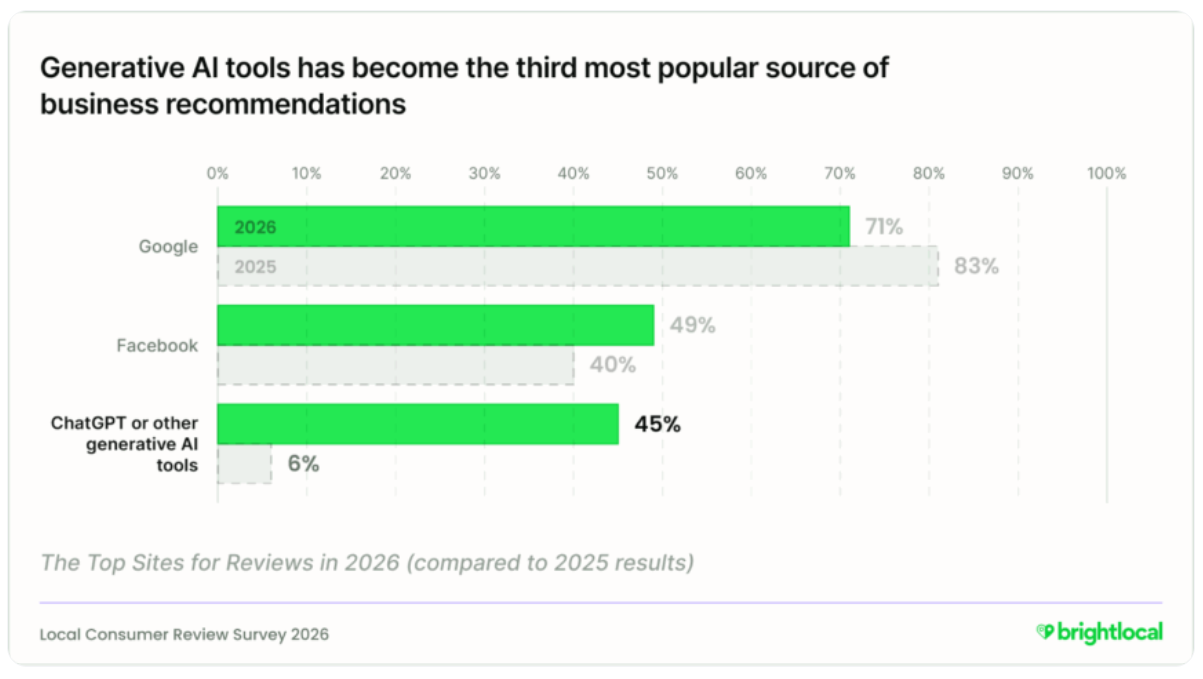
Yes. Customers are increasingly using AI search to find and compare local businesses alongside Google, maps, and review sites. According to BrightLocal’s 2026 Local Consumer Review Survey, 45% of consumers used AI tools for local business recommendations in the previous 12 months, up from 6% in 2025.
Someone looking for a landscaper might ask ChatGPT to recommend companies that install patios nearby, then follow up with questions about customer reviews, services, and experience. The businesses mentioned could become their starting point for deciding who to contact.
AI is also changing how people interact with traditional search results. A 2025 Pew Research Center study found that Google users clicked a regular search result in 8% of visits when Google AI Overviews appeared, compared with 15% when no AI summary was shown.
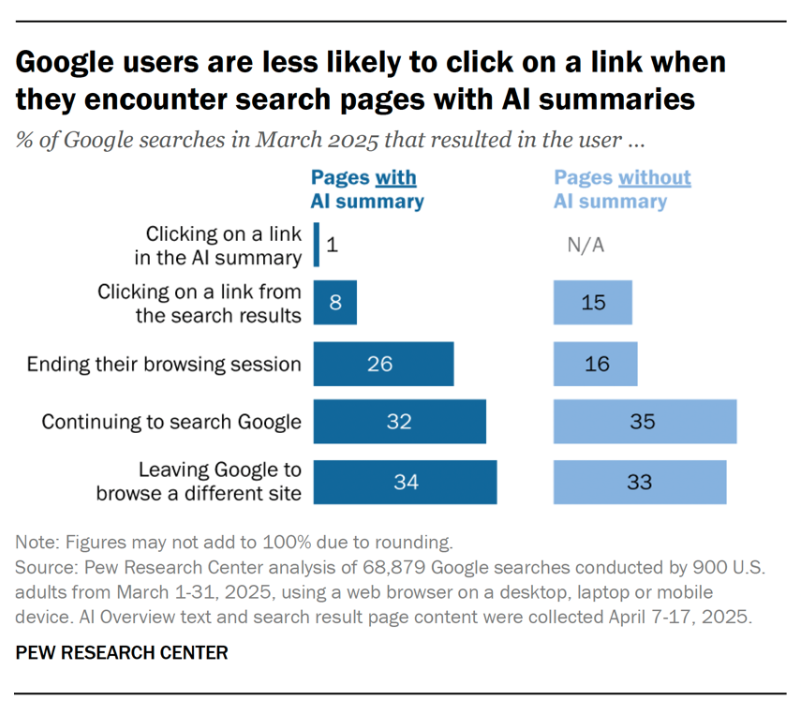
These are sometimes called zero-click searches, where someone gets the information they need without opening another website. For your business, that means a customer may learn about your services through an AI answer without visiting your website, making accurate online information increasingly important. It also means web traffic alone may not tell you how often customers encounter your business in search results.
Want to see how AI describes your business? Try this quick check:
- Open ChatGPT, Perplexity, or another AI tool with web search.
- Search for something a customer might ask, such as “Which landscaping companies install patios in [your city]?”
- Check which businesses appear, how they’re described, and what sources are cited.
- Repeat with different services or nearby locations, noting any missing or inaccurate information.
If AI describes an outdated service or incorrect location, check your website and business listings for the source of that information. If your business doesn’t appear, review how clearly you describe your services and locations online. You can also compare your listings and reviews with those of the businesses that do appear.
Results vary because AI systems can retrieve different sources and generate different answers. Checking several relevant searches over time can help you understand your AI search share of voice, or how often your business appears compared with competitors. One response won’t tell you how visible your business is overall or why a particular business was recommended.
Is AI sending customers to your competitors?
Enter your website to get a free AI visibility report and see what to fix first.
9. How do I get my business to show up in AI search results?
Improving your visibility starts with making accurate, helpful information about your business easy to find online. AI search optimization for small business builds on many of the same practices that help customers discover and trust you through traditional search engines.
You may also hear this called answer engine optimization (AEO) or generative engine optimization (GEO). Both focus on making your business information easier for AI search tools to find, understand, and reference.
There’s no guaranteed way to appear in AI recommendations, but these four steps can help strengthen your online presence.
- Keep your business information accurate: Check that your business name, phone number, hours, services, and service areas are correct on your Google Business Profile and other important directories. If you recently expanded into a neighboring town, make sure that service area is reflected consistently. Thryv’s Online Listings Management helps you manage business information across directories without updating each listing individually.
- Build and maintain your reviews: Ask satisfied customers for reviews, respond to feedback, and monitor what people say about your business. Reviews give potential customers useful information about your service and reputation. Thryv’s Reputation Management helps you request and manage reviews from one place.
- Make your website useful: Clearly describe your services, locations, qualifications, and how customers can contact you. For example, an electrician offering emergency repairs should explain which problems they handle, where they provide service, and how customers can request help. Structured data, which is information added to a website’s code to describe its content, can also help search engines understand details about your business.
- Answer common customer questions: Add helpful FAQs or service-page information about pricing factors, appointment availability, and what customers should expect. Focus your content strategies on questions customers genuinely ask.
Start with the issue that’s most likely to confuse customers. If your online business information is inaccurate, correct your listings first. If your listings are accurate but your website doesn’t explain your services or locations clearly, prioritize those pages. Continue requesting and responding to reviews so customers have current feedback to consider.
Use Thryv’s free Online Presence Scan to identify issues with your business information.
Get the full visibility checklist
The free Small Business SEO & AEO Visibility Checklist takes you step by step through showing up on Google and in AI answers, so more searches turn into customer inquiries.
Put AI search to work for your business
Choose one business question you’ve been meaning to research, whether it’s comparing suppliers, evaluating software, or understanding a local requirement. Try an AI search tool, ask follow-up questions, and check sources before deciding.
Then consider how customers might find your business through those same tools. If your AI visibility check reveals inaccurate information or missing service details, start by correcting those issues.
If you’d rather have experts handle your search visibility, you can add Search Boosts, Thryv’s managed SEO and AEO service, to your Thryv plan.
“Things began to change almost immediately when I started using Thryv. We went from not even registering on the list to being number one on almost every search page.” – Robert P. Karwin, Law Office of Robert P. Karwin, Menifee, California, on Thryv’s SEO and website services.
Get found where customers search
See how Thryv can help your business show up on Google and in AI search. You choose how hands-on you want to be.
FAQs about AI search for small business
Yes, tools like ChatGPT, Perplexity, and Gemini offer free versions that small business owners can use for research. However, free plans may limit how often you can search or which features you can access. Start with a free tool to see how often you use it before deciding whether a paid plan is worthwhile.
Not for now. In BrightLocal’s 2026 survey, AI tools ranked third for local business recommendations, behind Google and Facebook. AI search and traditional search serve overlapping needs, and customers continue using Google Maps, business websites, and review platforms to evaluate local businesses. Keeping your information accurate across these channels helps customers find the details they need, regardless of how they start their search.
Yes. Google’s AI Mode can generate answers and recommend businesses based on a customer’s question, rather than presenting only traditional search results. Your business may appear in an AI-generated response even if it doesn’t rank first in regular search results, but inclusion isn’t guaranteed.
Checking your AI search visibility about once a month is a reasonable starting point. You should also check after making significant changes to your services, website, or service area. Use several relevant customer questions and compare results over time, since recommendations can vary between searches and tools.
No. Paying for SEO or AEO services doesn’t guarantee your business will appear in organic AI-generated recommendations. Expert-managed services can help you improve the business information and website content that support search visibility, but no provider controls which businesses an AI tool recommends.