At its worst, “marketing” means gimmicks and impossibly false promises. The product that makes you drop 20 pounds in a week? “That’s just marketing,” we say dismissively.
But at its best, marketing is so persuasive that we sometimes don’t even realize we’re falling for it. In today’s market, believable marketing claims rely less on hype and more on proof. Customers are more likely to trust brands that use real customer outcomes, before-and-after examples, video demonstrations, testimonials, and measurable results to support their messaging.
Those companies have given us reasons to believe their claims are true, whether those reasons are rational (like statistics and guarantees) or not so much (like celebrity endorsements and social proof). The strongest trust-building marketing strategies combine emotional persuasion with evidence that customers can immediately verify for themselves.
When we buy what a company is selling, both figuratively and literally, at least one of these 11 marketing claims was probably involved. These are the most unconventional marketing campaigns that will show you how to sell your products.
Try the New Thryv Experience
See what’s new — and why it gives your business an edge.
Key Takeaways
- The most effective marketing claims use proof-based messages, such as testimonials, demonstrations, and measurable results, rather than vague promises.
- Before-and-after examples, customer use cases, and video demonstrations help businesses build trust by showing real-world proof of their claims.
- Specific numbers, performance metrics, and reporting dashboards make marketing claims feel more credible and trustworthy to potential customers.
- Social proof, like review volume, star ratings, and customer testimonials, can influence buying decisions faster than traditional brand messaging.
- Businesses that combine credibility, transparency, and customer proof are more likely to build trust and drive more sales.
Table of Contents
- Marketing Claims Examples
- FAQs
- How Trust Drives Better Marketing Results
Marketing Claims Examples
1. The explanation.
2. The torture test.
3. The visual demonstration.
4. The numeric proof.
5. The guarantee.
6. The testimonial.
7. The social proof.
8. The endorsement.
9. The borrowed equity.
10. The head-to-head comparison.
11. The special ingredient.
1. The explanation.
Sometimes, no research survey or celebrity endorsement can top a solid explanation. A step-by-step demonstration can dispel doubts and misconceptions by showing you how the product works and why you need it.
For example, Ring makes a product that generations of humans have survived without: a video doorbell. Even consumers who like the idea have questions about how your doorbell could possibly allow you to talk to the mailman when you’re not home. In explaining Ring’s technology and installation, this video shows scenarios such as package deliveries and attempted burglaries, helping convince you of the need for the product. Modern brands often strengthen these marketing claims with customer testimonials, video reviews, and real-world use cases that show the product solving specific problems in everyday situations.
What Makes a Marketing Claim Believable?
A believable marketing claim explains exactly how a product or service works while showing proof that customers can trust. Step-by-step demonstrations, customer use cases, and visual examples help eliminate skepticism by answering questions before prospects even ask them.
2. The torture test.
Your SUV will probably never face anything worse than post-winter potholes or a dirt road now and then. But if an epic natural disaster were to strike your suburban neighborhood, you know your car could handle mud, water, rocks, or all of the above. You’ve seen it on TV.
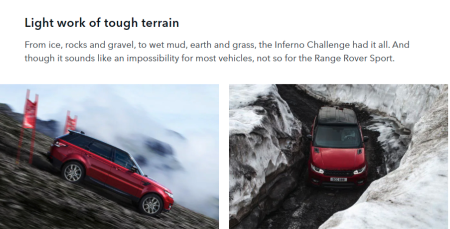
A staple of car commercials, the torture test shows the product can withstand stresses more challenging than those you’d face in everyday life—overcoming your possible objections about why it won’t work for you. Take this video in which a Range Rover Sport careens down from the icy summit of a Swiss Alp (cue the “do not attempt” fine print).
3. The visual demonstration.
The picture can be worth more than any number of words, especially for unique products that have to be seen to be believed. Before-and-after proof, live demonstrations, and visual customer success stories are especially effective because they allow potential buyers to see the transformation firsthand rather than relying on generic promises.
If you were to, say, saw your boat in half, could you just tape it back together? It’s unlikely anyone would believe that claim by Flex Tape, a super-strong, waterproof adhesive—unless they saw the feat with their own eyes in this video.
This type of proof-based marketing message works because customers can visually verify the claim instead of simply trusting the company’s wording.
4. The numeric proof.
Sometimes, numbers tell a more convincing story than words and pictures. Marketers often rely on quantitative evidence, such as rankings and research statistics, to back up qualitative claims that can’t be proven statistically. Businesses can strengthen these claims even further by using dashboards, customer reporting tools, and performance analytics to support their messaging with real metrics and measurable outcomes.
How Do Numbers Improve Marketing Trust?
Specific numbers make marketing claims feel more credible because they replace vague promises with measurable outcomes. Customers are more likely to trust statements like “40% faster response times” or “98% customer retention” than generic phrases like “best service” or “industry-leading support.”
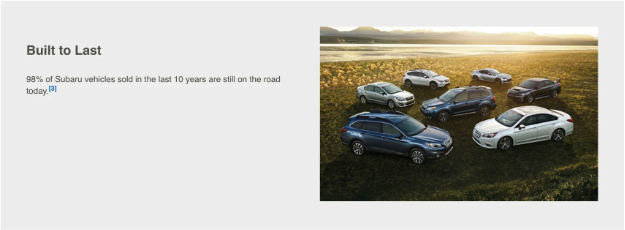
Subaru’s commercials give us the feels because they show kids growing up and dogs growing old while the car looks good as new. But the company’s “built to last” claim is rooted in numbers: 98 percent of Subaru vehicles sold in the last 10 years are still on the road today, according to a study of vehicle registrations.
Specific data points such as percentages, response times, customer satisfaction scores, and usage statistics help build credibility in marketing by giving customers concrete metrics to evaluate.
5. The guarantee.
No matter what you see, hear, or experience, you still feel a little nervous about shelling out money for a product you haven’t tried before. That is, until you hear the magic words: “or your money back.”
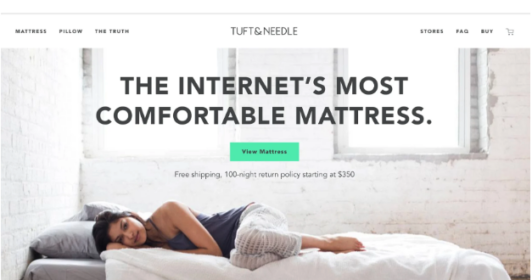
The best guarantees come with promises more specific than “100% satisfaction guarantee” (Does it count as being unsatisfied if you just changed your mind?) Consider this guarantee from Tuft & Needle, an internet mattress retailer. Knowing that few consumers will buy a mattress without lying on it first, the company offers a 100-night trial, promising to accept returned mattresses “for any reason” and donate them to charity.
6. The testimonial.
A company claiming its product is the best seems almost meaningless. But when other people back up the same claim—and they’re regular folks with problems like yours—you may be more inclined to believe it. Testimonials are even more effective when they focus on specific customer experiences, measurable results, or before-and-after outcomes instead of broad praise alone.
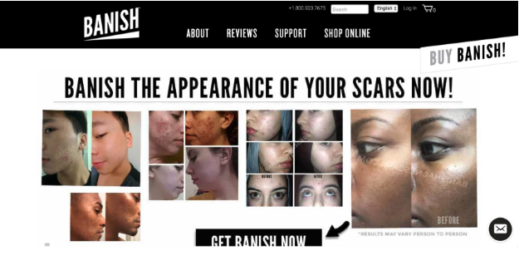
The Banish line of acne products was developed by an acne sufferer, who features her story on the website. But the first images you’ll see on the homepage showcase before-and-after photos from regular people.
Many businesses now feature service-specific testimonials, review snippets, and customer success stories across landing pages, emails, and product pages to reinforce trust throughout the buying journey.
7. The social proof.
For some companies, only a few strong testimonials are needed to create convincing marketing material. For others, it’s the volume of customers that speaks volumes. Today, social proof often includes review volume, average star ratings, response rates, and customer engagement metrics that help buyers quickly assess a business’s trustworthiness.
Social proof dates back way before social media and Amazon reviews. Think of McDonald’s, which spent decades updating its signs to reflect how many millions and eventually billions of customers it had served.
Today, businesses use customer reviews, Google Business Profile ratings, and user-generated content as trust signals across websites, email campaigns, and social media marketing.
And long before McDonald’s, advertising pioneer Claude C. Hopkins wrote this in the 1920s: “People are like sheep. They cannot judge values, nor can you or I. We judge things largely by others’ impressions, by popular favor. We go with the crowd.”
These trust-building marketing strategies work because people naturally look to other customers for reassurance before making purchasing decisions.
8. The endorsement.
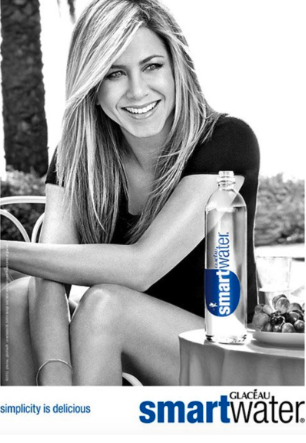
From consumer reports to athletes to Oprah, experts and celebrities have been telling us what to believe about products for decades—both explicitly and implicitly. We explicitly trust Jennifer Aniston’s choice in hair products because she’s inspired hairstyles since the debut of “The Rachel” 20 years ago. And we implicitly trust her choice in beverages—just because she’s Jennifer Aniston.
9. The borrowed equity.
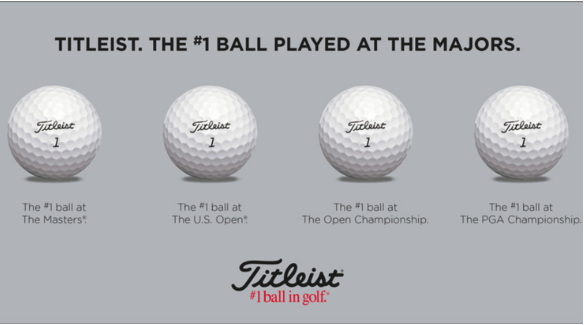
Companies don’t always have to pay a celebrity to reap the benefits of someone else’s brand. Sometimes, the mere association of your product with a well-respected entity helps consumers trust it.
If Titleist is good enough for the professionals at all four major tournaments, why wouldn’t it be good enough for you?
10. The head-to-head comparison.
All products have competition—some just won’t admit it. Other companies go head-to-head with competitors to make consumers believe their products are superior. Think of seemingly any product involving problematic liquids (diapers, paper towels, stain removers).
In the ultra-competitive fight for cell phone customers, Sprint almost exclusively focuses its advertising on attacking competitors and even poached Verizon’s former spokesperson and slogan in their ads.
11. The special ingredient.
Not all marketing claims are unique—unless the law says they are. A branded term or phrase provides a company with indisputable evidence that it alone owns the claim.
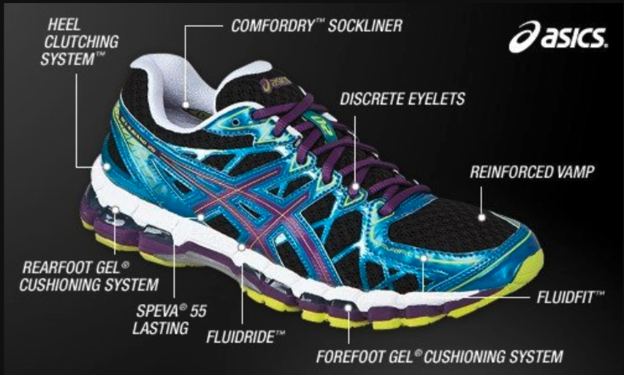
In this graphic, Asics probably wouldn’t sway us by simply labeling its shoe as the most comfortable on the market. Instead, it uses nine descriptive terms, seven of which are trademarked or copyrighted. A FluidFit shoe with a Heel Clutching System, Comfordry Sockliner, (and whatever Speva 55 is) sounds like it was engineered to keep our feet happy.
FAQs
Q: What makes a marketing claim believable?
A: Marketing claims become more believable when they include measurable results, customer testimonials, demonstrations, or real-world examples that support the message with proof.
Q: How do numbers improve marketing trust?
A: Specific numbers improve marketing trust because they give customers concrete evidence to evaluate instead of relying on vague or exaggerated claims.
Q: Why do testimonials improve conversions?
A: Testimonials improve conversions because potential customers trust real experiences from other buyers more than direct brand messaging alone.
Q: What are examples of proof-based marketing messages?
A: Proof-based marketing messages include before-and-after examples, customer success stories, review snippets, performance metrics, guarantees, and video demonstrations that support claims with evidence.

The Ultimate Marketing Guide for Businesses
Get the marketing fundamentals to attract customers, build loyalty, and grow your business with confidence.
Download
How Trust Drives Better Marketing Results
Modern consumers are skeptical of exaggerated advertising, which is why the most effective marketing claims are backed by evidence that customers can see, measure, or verify themselves. Testimonials, review snippets, customer success stories, video demonstrations, and real performance metrics all help businesses build trust faster and convert more buyers.