
Key Takeaways
- AI lead generation helps small businesses automatically capture, qualify, and follow up with leads, making it easier to convert more inquiries without hiring a sales team.
- Start by fixing your lead-capture process. Fast responses to missed calls, web forms, and chat inquiries often have a bigger impact than driving additional traffic.
- For most local businesses, inbound AI lead generation delivers the fastest return by improving online visibility, automating follow-up, and helping you respond to customers who are already searching for your services.
- All-in-one AI platforms reduce missed opportunities by combining listing management, lead capture, CRM, marketing automation, and reporting into a single system with a single login.
- Measure one improvement at a time. Focus on a single stage of your lead generation process for 30 days, track the results, then build on what’s working instead of trying to automate everything at once.
- The goal isn’t simply to use AI; it’s to stop losing qualified leads you’ve already earned by making every customer interaction faster, more organized, and easier to manage.
Why Small Businesses Are Turning to AI for Lead Generation
The biggest reason small businesses are adopting AI for lead generation isn’t that it’s trendy; it’s because it gives owners back something they can never make more of: time. And just as importantly, it helps make sure valuable leads don’t slip through the cracks. According to Salesforce’s latest SMB Trends Report, 90% of small businesses using AI say it makes their operations more efficient, proving that AI delivers practical value, not just hype.
For most local businesses, lead generation breaks down for one simple reason: there’s no one dedicated to managing it. You’re out on service calls, meeting clients, ordering inventory, or managing employees while new inquiries arrive through your website, Google Business Profile, social media, or voicemail. By the time you have a chance to respond, the customer may have already called someone else.
This is where AI changes the equation. Instead of relying on you to be available every minute of the day, AI can capture leads around the clock, respond instantly to common questions, qualify inquiries based on intent, and trigger automatic follow-up messages so prospects stay engaged until you’re ready to step in. Rather than replacing the personal touch, AI makes sure every potential customer receives one.
If you’re skeptical, that’s understandable. Most small business owners don’t need another complicated system to learn; they need fewer manual tasks and better results. The return on investment comes from reducing missed opportunities, shortening response times, and helping you focus your attention on the leads most likely to become paying customers. Instead of spending hours chasing every inquiry, you spend your time talking to the people who are actually ready to buy.
Try the New Thryv Experience
See what’s new — and why it gives your business an edge.

How to Use AI for Lead Generation: A Framework
The best way to approach AI-driven lead generation is to improve the process you already have rather than replace it. Start where your leads are already finding you (your website, Google Business Profile, social media, and phone), then layer AI into the parts of the customer journey where owners typically lose time: capturing inquiries, qualifying prospects, following up, and measuring results. These six steps work whether you have a full office staff or you’re running the business yourself.
Step 1: Get found with AI-optimized listings.
The first AI lead-generation win for a local business is visibility. Before AI can help convert leads, people need to find you. That means keeping your business information accurate across online directories and maintaining a complete, optimized Google Business Profile so you appear in local search results and AI-powered search experiences.
Consistent business listings build trust with both customers and search engines, while an optimized profile, with updated hours, services, photos, reviews, and business descriptions, gives potential customers the information they need to contact you. Thryv helps simplify the local listings process by syncing your business information across major directories, reducing the manual work required to keep everything up to date.
Step 2: Capture leads with AI chat, forms, and missed-call text-back.
Most lost leads aren’t caused by poor marketing, but rather by missed opportunities to respond. Someone calls while you’re with a customer. A website visitor fills out a form after business hours. A prospect has a quick question but doesn’t want to wait until tomorrow. AI-powered web chat, online forms, and missed-call text-back features make sure those inquiries receive an immediate response, even when you can’t answer personally. Capturing every lead is often the fastest improvement a small business can make because it protects the marketing dollars you’re already spending.
Step 3: Qualify and score leads automatically.
Not every lead deserves the same amount of attention. AI lead scoring helps prioritize the opportunities most likely to become customers by evaluating signals such as the service requested, location, urgency, referral source, previous interactions, and how the prospect engaged with your business.
Instead of treating every inquiry equally, you can quickly identify which leads need immediate attention and which can enter a nurturing sequence. This helps you spend more time selling and less time sorting through inquiries. With Thryv’s AI Lead Insights, AI automatically scores and prioritizes incoming leads so you can focus on the prospects most likely to convert instead of guessing where to spend your time.
Step 4: Follow up instantly with AI-assisted messages.
Response time has a direct impact on conversion rates. The sooner a prospective customer hears back from you, the more likely they are to stay engaged. AI-assisted messaging can instantly send personalized replies acknowledging an inquiry, answer common questions, confirm receipt of a request, and guide prospects toward scheduling an appointment or consultation. While you’re finishing a service call or driving between jobs, your business is already responding. The result is a better customer experience without requiring you to monitor every communication channel throughout the day.
Step 5: Nurture leads with automated email and text sequences.
Not every customer is ready to buy after the first interaction, and that’s okay. AI-assisted email and SMS sequences keep your business top of mind by sending timely follow-ups over the following days or weeks. A prospect might receive a helpful maintenance tip, a customer success story, a recent five-star review, or a reminder to schedule service before eventually receiving a limited-time offer. Instead of relying on memory to follow up, AI creates consistent communication that builds trust until the customer is ready to take the next step.
Step 6: Measure what’s working and double down.
Generating more leads only matters if you know where your best customers are coming from. AI-powered reporting helps connect marketing activity to business outcomes by showing which channels generate qualified leads, which sources drive paying customers (not just website traffic), your cost per lead, and where prospects drop out of the sales process.
These insights make it easier to invest in the marketing efforts that consistently produce revenue while reducing spending on campaigns that aren’t delivering results. Over time, this creates a smarter, more efficient lead-generation system that keeps improving as your business grows.
Turn More Inquiries Into Booked Customers
See how Thryv Leads captures, organizes, and follows up with every lead automatically, so nothing slips through the cracks. Explore the lead generation tools built for small businesses.
Inbound vs Outbound AI Lead Generation: Which Is Right For You?
For most local and service-based businesses, inbound AI lead generation delivers faster results with less effort than outbound prospecting. Instead of chasing people who may not need your services, inbound marketing helps you capture demand that’s already there – people actively searching online, visiting your website, reading reviews, or calling your business. Outbound strategies still have their place, but they’re typically better suited to B2B companies with dedicated sales teams and longer sales cycles.
Inbound AI Lead Generation
Inbound lead generation focuses on making it easy for customers to find and contact you when they’re ready to buy. AI strengthens every step of that journey by improving visibility in local search, capturing inquiries instantly, and following up before a potential customer moves on to a competitor.
For a local business, that often means:
- Keeping your Google Business Profile and online listings accurate and optimized.
- Using AI-powered web chat to answer questions 24/7.
- Responding immediately to missed calls with automated text messages.
- Encouraging and managing customer reviews to build trust.
- Sending AI-assisted follow-up emails and texts after someone reaches out.
These are the highest-impact improvements for businesses that depend on inbound demand, such as HVAC companies, plumbers, electricians, roofers, landscapers, medical practices, salons, and home service providers.
Outbound AI Lead Generation
Outbound AI lead generation takes a different approach. Instead of waiting for prospects to contact you, AI helps identify potential customers, build prospect lists, personalize cold emails, and automate outreach campaigns.
This works well for businesses selling higher-ticket services to other businesses, where relationships develop over weeks or months rather than after a single phone call. Marketing agencies, software companies, consultants, and commercial service providers often benefit from outbound AI because they have the time and sales process to nurture those conversations.
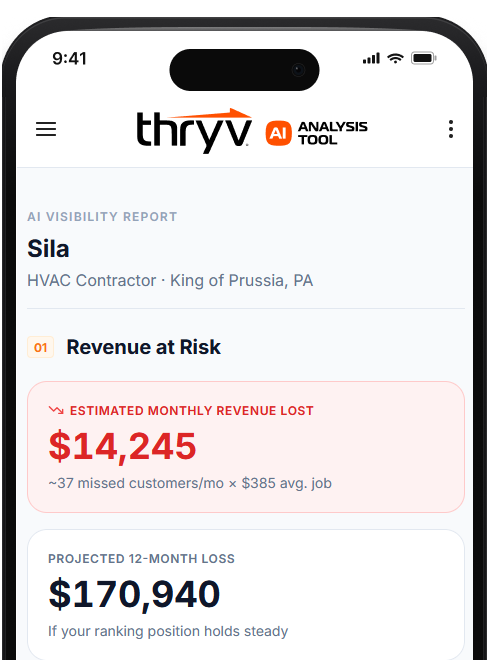
See how your business stacks up against competitors
Get a free AI-powered report showing where you rank online and what to fix first.
Which Approach Should You Choose?
For most small businesses, the answer is simple: start with inbound. If customers are already searching for the services you provide, your biggest opportunity isn’t finding more people to contact; it’s making sure every existing opportunity gets captured and followed up quickly. Once that system is running smoothly, you can explore outbound campaigns to create additional demand.
Email marketing is a good example. According to Constant Contact’s 2024 Small Business report, 53% of small business owners use email marketing as one of their most frequent strategies for finding and retaining customers. AI makes that channel even more effective by personalizing messages, automating follow-up sequences, and sending the right content at the right time without requiring constant manual work.
The best strategy isn’t choosing between inbound and outbound; it’s matching your lead generation approach to how your customers actually buy. For most local businesses, that means building an AI-powered inbound system first, then expanding from there as your business grows.
Turn AI Into More Leads, Not More Work
AI isn’t replacing the relationships that help small businesses grow. It’s removing the friction that keeps those relationships from happening in the first place.
The businesses seeing the biggest results with AI lead generation aren’t necessarily generating more traffic. They’re responding faster, capturing more inquiries, prioritizing the right opportunities, and following up consistently without adding more work to their day.
Start with one improvement that solves your biggest bottleneck, whether that’s responding to missed calls, automating follow-up, or qualifying incoming leads. Measure the results over the next 30 days, then build from there. Small, consistent improvements often deliver a bigger return than trying to automate everything at once.
When your listings, website, lead capture, CRM, and marketing automation work together in one place, AI becomes more than another tool. It becomes a system that helps you turn more inquiries into customers while giving you more time to focus on running your business.
See AI Lead Generation In One Platform
Book a Thryv demo and watch how get-found, lead capture, and automated follow-up work together in a single login.
Frequently Asked Questions About AI Lead Generation
AI lead generation uses artificial intelligence to help small businesses attract, capture, qualify, and nurture potential customers. AI can automate tasks like responding to website inquiries, sending follow-up emails or texts, scoring leads based on buying intent, and organizing customer information in a CRM. This helps business owners convert more leads while spending less time on manual administrative work.
AI helps generate more leads by improving both visibility and response times. It can optimize your online presence, power website chat, respond to missed calls with automated text messages, personalize follow-up communications, and identify which marketing channels produce the highest-quality leads. Instead of replacing your sales process, AI helps ensure fewer opportunities are missed.
The best AI lead generation tools depend on your business needs, but many local businesses benefit most from all-in-one platforms that combine online listings management, website lead capture, CRM, marketing automation, AI-powered messaging, and reporting. Having these tools connected in a single platform makes it easier to manage leads from first contact through conversion without switching between multiple systems.
Yes. AI can deliver a strong return on investment by reducing missed opportunities, improving response times, automating repetitive tasks, and helping business owners focus on the leads most likely to become paying customers. For many small businesses, even modest improvements in lead response and follow-up can result in more appointments, higher conversion rates, and increased revenue.
Start by identifying where leads are slipping through the cracks. For most small businesses, the fastest wins come from optimizing your online listings, adding AI-powered website chat or lead forms, enabling missed-call text-back, automating follow-up emails and text messages, and tracking which marketing channels generate qualified leads. Once one area is working well, expand your AI strategy gradually to improve the rest of your customer journey.